How to Fix Poor Sleep Hygiene as a Working Professional

Dr. Glenn J. Landry, PhD · Sleep and circadian rhythms scientist
Updated · 11 min read
The short version
Sleep hygiene is the set of daily habits and bedroom conditions that affect your sleep. Some enhance sleep quality and some detract from it. That's the difference between good and poor sleep hygiene. For busy professionals, I teach that the fix that matters most isn't another tip. It's a consistent sleep window your body clock can count on, with caffeine, alcohol, light and work timed around it.
You've probably tried the tips already. In studies of people with insomnia, those given tips alone improved only modestly.[2] In my experience they work best on top of a steady schedule, and timing is something you can change. Let's work through it together.
Key takeaways
- Canada's guidelines for adults aged 18 to 64 call for 7 to 9 hours of good-quality sleep on a regular basis, with consistent bed and wake-up times.[11]
- A meta-analysis suggests finishing a regular coffee (107 mg of caffeine) at least 8.8 hours before bed; bigger doses need longer.[17]
- A nightcap can speed up falling asleep, but it disrupts the second half of the night.[18]
- Very long hours (over 55 a week) and high job demands have each been linked to later sleep problems.[5][6]
What is sleep hygiene, and does it actually work?
Sleep hygiene sounds clinical. As I teach it, it's a set of behaviors and practices that can have an impact on your sleep, good or bad.
Does it work? Partly. A 2015 review found that research generally supports an association between individual recommendations and nighttime sleep, but their direct effects remain largely untested in the general population.[1] For people with insomnia, a 2018 review of 15 studies found small to medium improvements, significant only on self-reported measures. Sleep hygiene education was less effective than cognitive behavioral therapy for insomnia (CBT-I).[2] A 2025 review of 42 trials agreed, though most had a high risk of bias.[3]
Here's how I put it for insomnia:
“We now know from the science that sleep hygiene by itself is one of the least impactful in terms of actually improving someone's sleep. Part of the reason is that if you only address sleep hygiene, but you do not address circadian regulation, you won't have near the impact.”
That fits the evidence: the American Academy of Sleep Medicine suggests clinicians not use sleep hygiene as a single-component therapy for chronic insomnia,[4] and it is less effective than CBT-I.[2] So I start with the body clock. Circadian rhythms are daily biological rhythms of physiology and behavior. We all have them. In my experience, habits help most when they support your body's own schedule.
Why is good sleep hygiene so hard when you have a demanding job?
You probably know the tips already: no late coffee, no phone in bed. The trouble is a job that doesn't care about them, not a character flaw.
In the Whitehall II study of British civil servants, people working more than 55 hours a week were more likely to develop difficulty falling asleep, and possibly shorter sleep, than those working 35 to 40. About 7% of the long-hours group developed trouble falling asleep, against 3.5%: small numbers, wide margin of uncertainty.[5]
Pressure too. In a Swedish study of 4,827 workers, higher work demands predicted disturbed sleep two years later, while overtime and shift work did not. Disturbed sleep also predicted higher demands later: a two-way street.[6]
Then there's the evening. Researchers call going to bed later than planned, with nothing forcing you to, bedtime procrastination; in a survey of 177 people it was related to reports of insufficient sleep.[7] ("Revenge bedtime procrastination" began as a popular label and is now being studied: in a survey of 393 military servicemembers, published in 2026, more work role overload went with more bedtime procrastination.[8]) Feeling you must answer messages fast, called workplace telepressure, was linked to burnout, absenteeism and sleep quality in another study.[9]
That's the bad news. Here's the good: just because it's normal doesn't mean it's healthy, and it doesn't mean it's inevitable. For the performance cost, see our guide to sleep and productivity.
Why does a consistent sleep window matter more than any single tip?
My guidance is to build and protect a routine, predictable sleep window. The consensus minimum for adults is at least seven hours of actual sleep,[10] and I teach an eight-hour window to get there. Canada's 24-hour movement guidelines for adults aged 18 to 64 say 7 to 9 hours of good-quality sleep on a regular basis, with consistent bed and wake-up times.[11]
Why consistent? I teach that your brain needs to anticipate your sleep, so it can prepare for that window.
A large UK study also backs regular timing. Among 60,977 adults who wore accelerometers (average age about 63), those in the four more-regular fifths of sleep timing had a 20% to 48% lower risk of dying over roughly six years than the least regular fifth. Regularity was also a stronger predictor than sleep duration.[12] It is an association, and two of the authors disclose ties to circadian-health companies, so I treat it as a signpost, not a promise.
The good news: you can practice regularity. Choose a wake time you can keep seven days a week, then protect the window around it. Here's the line I come back to: build the window, protect it with what you do by day and when you can't sleep at night, and let your sleep accountant fill it. Your sleep accountant is what I call the process that keeps track of the sleep your body needs.
Is it bad to sleep in on weekends?
We've all said it: "I'll catch up on the weekend." The research is mixed. In a small lab trial of healthy young adults, weekend recovery sleep added about 1.1 hours. But the body clock was delayed afterward, and in the recovery group insulin sensitivity still fell by about 9% to 27% when short nights resumed. The authors concluded it was not an effective strategy to prevent metabolic dysregulation.[13]
In a Swedish cohort of 43,880 people, adults under 65 who slept little on weekdays but long on weekends had a mortality rate no different from the reference group, so long weekend sleep may compensate. That is self-reported, and an association.[14]
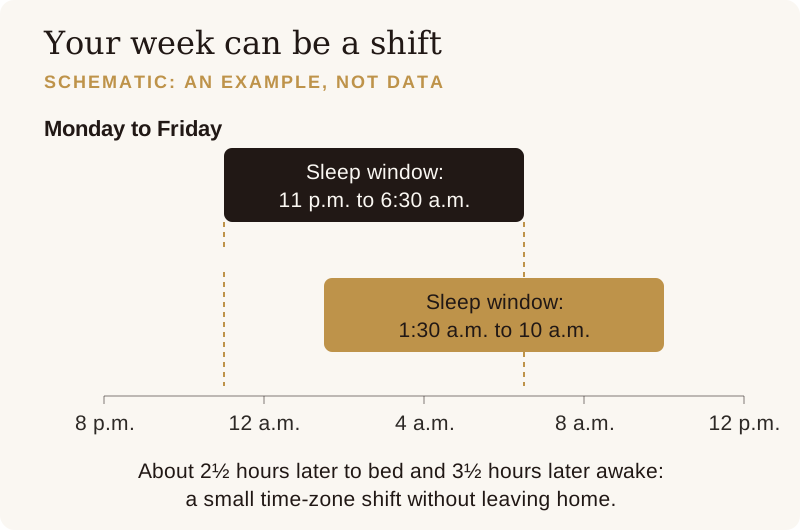
“We're all shift workers in that if there is a difference between our Monday, our Wednesday, our Friday, our Saturday and our Sunday… and our sleep window is different for each of those, then we are shift workers. It's just a matter of the degree…”
In my experience, sleeping in may help repay a short week, but it pushes your clock later and makes Monday harder. Researchers call a gap like this social jetlag.[15] Let's aim for a weekday schedule you can keep, so the weekend does not have to rescue you. More in our circadian rhythms guide.
How should you time light?
We all know what we need to do: eat right, exercise and get plenty of sleep. What most people don't realize is that when you do these things can matter as much as what you do. I'd argue sometimes more. Timing is everything.

What about caffeine, an evening drink, and dinner?
Now the rest of the day. Let's talk about caffeine, the evening drink and the late dinner.
How do you switch off work at night?
Maybe you're lying there replaying the day, or rehearsing tomorrow's meeting. The hardest part of the evening isn't the bedroom. It's your head. Let's give it somewhere to put all that.
What about blue-blocking glasses? I recommend them in my coaching: good amber lenses for the two hours before bed. The evidence is mixed: a 2023 Cochrane review could not say whether blue-light filtering lenses improve sleep quality.[22] So dim the house too, and treat the glasses as one tool, not a cure. Never wear them while driving.
What about movement, naps and nights you can't sleep?
You don't have to give up evening workouts: a review of 23 studies in healthy adults did not support the idea that evening exercise harms sleep, though sleep might be impaired after vigorous exercise ending within an hour of bedtime.[23] And I want you to get up and move every 30 to 60 minutes; in my teaching, long sitting sends your body clock a weak day signal.
In a lab study of 24 healthy young good sleepers held to about five hours of sleep, a 10-minute nap at 3 p.m. improved sleepiness and performance right away, while a 30-minute nap first caused impaired alertness.[24] In my coaching, even 10 to 15 minutes can be restorative, and up to about 45 minutes is the sweet spot. Never over 90 minutes: that isn't a nap, it's daytime sleep. The natural window is roughly six hours after waking; at work, take the length the day allows. The study tested naps only up to 30 minutes; longer naps can leave you groggy, so allow time to wake up before anything critical.
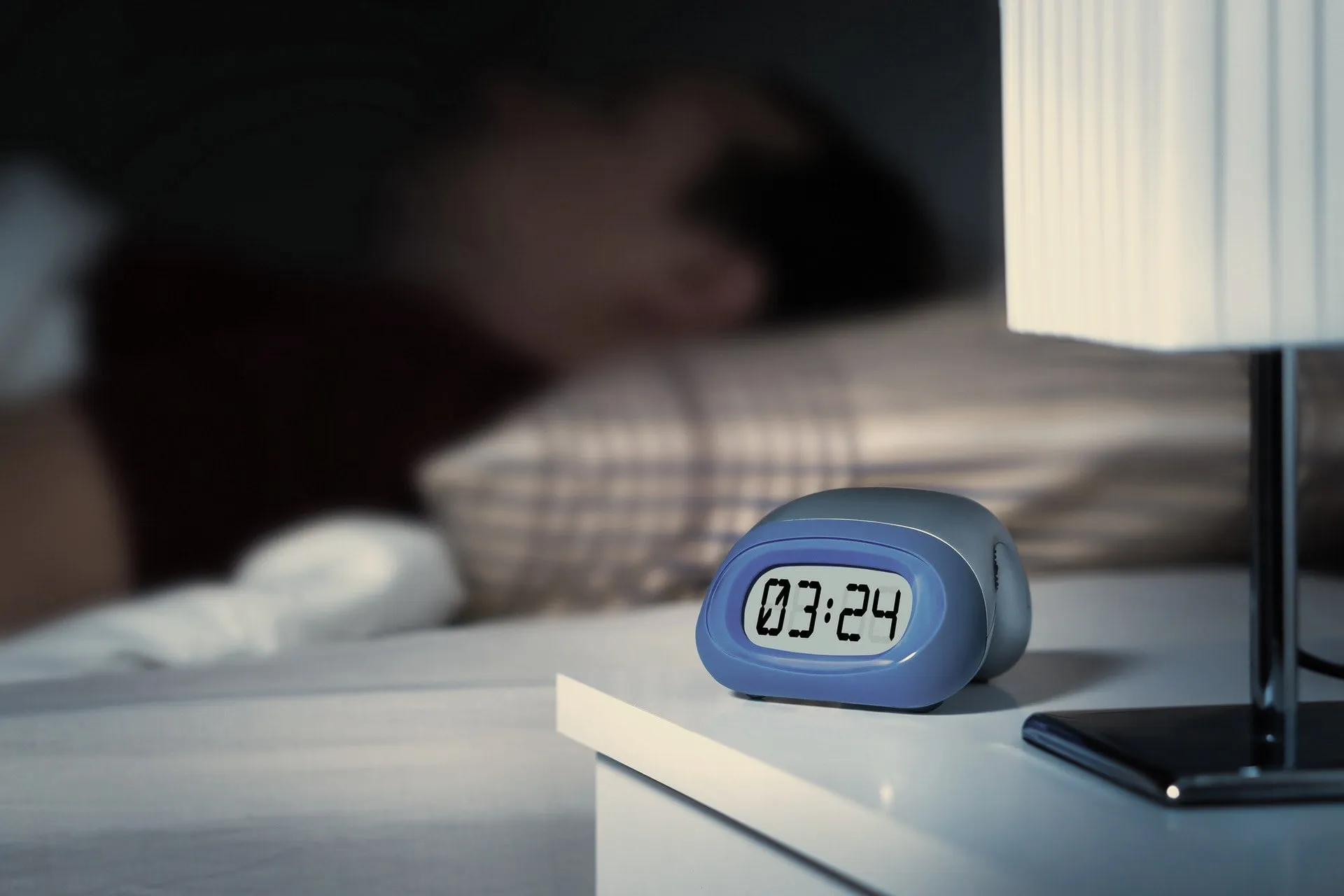
Lying awake? As I teach: "What you do when you can't sleep matters. It determines your capacity for future sleep." Don't turn night into day: skip the bright light, the activity and the snack. If you do get up, keep it dim and quiet. And keep the bedroom dark, quiet, cool and for sleep, not work. It's entirely up to you.
When is poor sleep more than poor sleep hygiene?
Please don't skip this one. Loud snoring, gasping or pauses in breathing, or heavy sleepiness despite enough time in bed? Talk to your physician. As I teach: "If you have sleep apnea and you do not address it, none of what I'm doing for you here is going to make a difference."
If trouble sleeping keeps coming back despite a steady schedule, see your physician. For chronic insomnia disorder, the American Academy of Sleep Medicine strongly recommends multicomponent CBT-I, and suggests clinicians not use sleep hygiene alone.[4] I don't recommend melatonin or sleep medications as a fix. If you're using them, talk to your physician before changing anything.
Where do we go from here?
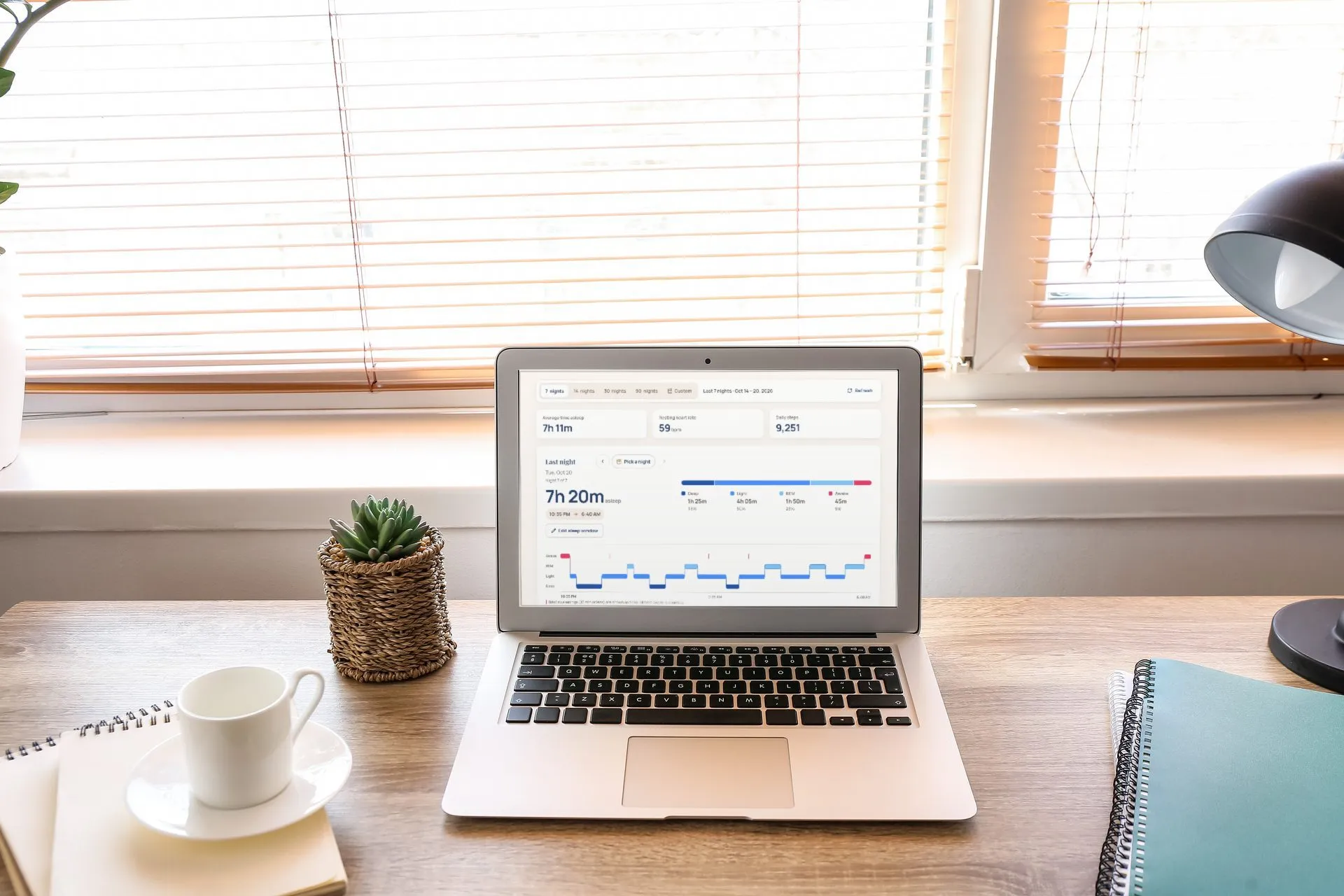
If none of those red flags fit, let's measure first. The Free Sleep Assessment shows us where to start; it is not a diagnosis. A tracker gives you data, not decisions. Your wearable can tell you what happened to your sleep last night. We tell you what to do about it. In the Advanced Sleep Assessment, we review the sleep stages your wearable estimates. If you want one-to-one guidance, coaching with Dr. Glenn J. Landry, PhD is a higher level of care, and we build the plan around your life together.
Working shifts? Within any shift system there are ways to adapt: see our night-shift guide. Leading a team? Our workshops are a good place to start.
Frequently asked questions
What is sleep hygiene?
Sleep hygiene is the set of daily habits and bedroom conditions that can help or hurt your sleep. That covers when you sleep, how you use caffeine, alcohol, light and screens, and how you wind down. It's a toolbox, not a treatment.
Does sleep hygiene actually work?
Modestly. For insomnia, a review found small to medium improvements, on self-reported measures only,[2] and a 2025 review found less benefit than CBT-I.[3] The AASM suggests clinicians not use it alone for chronic insomnia.[4] In my experience it works best on a consistent sleep window. Still struggling? Take the Free Sleep Assessment or talk to your physician.
What are signs of poor sleep hygiene?
Habits worth a second look: irregular bed and wake times,[11] caffeine late in the day,[17] a nightcap to fall asleep,[18] and your phone in bed.[20] These habits are not a diagnosis. If trouble sleeping persists, talk to your physician.
How long before bed should I stop caffeine?
A meta-analysis concluded that a regular coffee (107 mg of caffeine) should be finished at least 8.8 hours before bed, on average, and a 217.5 mg dose 13.2 hours.[17] For a 10:30 p.m. bedtime, a regular coffee means early afternoon. Caffeine clears slowly, so you may need to stop earlier.
Is it bad to sleep in on weekends?
It's mixed. In a Swedish cohort, long weekend sleep may partly offset short weekdays,[14] but in a lab trial it delayed the body clock and did not prevent the metabolic effects of short sleep.[13] I teach a weekday schedule you can keep, so the weekend doesn't have to rescue you.
For individuals
Find out which habits are costing you sleep
In my experience, tips help most when they fit your life and your body clock. Some people want the data; others just want to know what to do. Either way, the Free Sleep Assessment is where we start, and we guide you from there.

About the author
Dr. Glenn J. Landry, PhD
Sleep and circadian rhythms scientist · Founder, NEOS Performance
Dr. Glenn J. Landry, PhD, is a sleep and circadian rhythms scientist with 30 years in sleep science, and the founder of NEOS Performance in Delta, BC. He came to this field honestly: he couldn't sleep, starting at 13. He earned his PhD at Simon Fraser University and completed a postdoctoral fellowship at the University of British Columbia, studying sleep, aging and cognition. He created the Surviving Shift Work® program. Today Dr. Landry and the NEOS team guide executives, shift workers, first responders and organizations toward Elite Sleep®, translating science for each person's lived experience.
More about Dr. Glenn J. Landry, PhD Sources (24)
- [1] Irish LA, Kline CE, Gunn HE, Buysse DJ, Hall MH. The role of sleep hygiene in promoting public health: a review of empirical evidence. Sleep Medicine Reviews. 2015;22:23–36. (Narrative review.) Irish et al., 2015 (PubMed)
- [2] Chung KF, Lee CT, Yeung WF, Chan MS, Chung EW, Lin WL. Sleep hygiene education as a treatment of insomnia: a systematic review and meta-analysis. Family Practice. 2018;35(4):365–375. (15 studies, people with insomnia; none compared with a no-treatment or sham group, so the before-and-after gains cannot be credited to the tips alone.) Chung et al., 2018 (PubMed)
- [3] Ruan JY, Liu Q, Chung KF, Ho KY, Yeung WF. Effects of sleep hygiene education for insomnia: a systematic review and meta-analysis. Sleep Medicine Reviews. 2025;82:102109. (42 randomized trials, 4,245 adults with insomnia; 85.71% of trials at high risk of bias.) Ruan et al., 2025 (PubMed)
- [4] Edinger JD, Arnedt JT, Bertisch SM, et al. Behavioral and psychological treatments for chronic insomnia disorder in adults: an American Academy of Sleep Medicine clinical practice guideline. Journal of Clinical Sleep Medicine. 2021;17(2):255–262. (Strong recommendation for multicomponent CBT-I; conditional recommendation against sleep hygiene as a single-component therapy.) Edinger et al., 2021 (PubMed)
- [5] Virtanen M, Ferrie JE, Gimeno D, et al. Long working hours and sleep disturbances: the Whitehall II prospective cohort study. Sleep. 2009;32(6):737–745. (British civil servants; observational. Difficulty falling asleep: OR 3.68, 95% CI 1.58–8.58, from 10 cases among 145 people working over 55 hours (6.9%) vs 21 of 593 (3.5%); the fully adjusted OR was 4.12. Waking unrefreshed and short sleep weakened after adjustment.) Virtanen et al., 2009 (PubMed)
- [6] Åkerstedt T, Garefelt J, Richter A, et al. Work and sleep: a prospective study of psychosocial work factors, physical work factors, and work scheduling. Sleep. 2015;38(7):1129–1136. (4,827 Swedish workers, questionnaires two years apart; observational.) Åkerstedt et al., 2015 (PubMed)
- [7] Kroese FM, De Ridder DT, Evers C, Adriaanse MA. Bedtime procrastination: introducing a new area of procrastination. Frontiers in Psychology. 2014;5:611. (Small online survey, N = 177; observational.) Kroese et al., 2014 (PubMed)
- [8] Barrow TR, Cooper CR, Revell L, Haugen T, Gregg BT. The characterization of revenge bedtime procrastination in military servicemembers. Military Medicine. 2026;191(5–6):e1161–e1167. (Cross-sectional survey of 393 servicemembers; self-reported; observational.) Barrow et al., 2026 (PubMed)
- [9] Barber LK, Santuzzi AM. Please respond ASAP: workplace telepressure and employee recovery. Journal of Occupational Health Psychology. 2015;20(2):172–189. (Scale-development studies; observational.) Barber & Santuzzi, 2015 (PubMed)
- [10] Watson NF, Badr MS, Belenky G, et al. Recommended amount of sleep for a healthy adult: a joint consensus statement of the American Academy of Sleep Medicine and Sleep Research Society. Journal of Clinical Sleep Medicine. 2015;11(6):591–592. Watson et al., 2015 (journal)
- [11] Ross R, Chaput JP, Giangregorio LM, et al. Canadian 24-Hour Movement Guidelines for Adults aged 18–64 years and Adults aged 65 years or older: an integration of physical activity, sedentary behaviour, and sleep. Applied Physiology, Nutrition, and Metabolism. 2020;45(10 Suppl 2):S57–S102. (The wording "7 to 9 hours of good-quality sleep on a regular basis, with consistent bed and wake-up times" is from the CSEP guideline page for adults 18–64.) Ross et al., 2020 (CSEP)
- [12] Windred DP, Burns AC, Lane JM, et al. Sleep regularity is a stronger predictor of mortality risk than sleep duration: a prospective cohort study. Sleep. 2024;47(1):zsad253. (UK Biobank, 60,977 adults, mean age 62.8; observational. Two authors disclose research funding from, and co-founding of, circadian-health companies.) Windred et al., 2024 (PubMed)
- [13] Depner CM, Melanson EL, Eckel RH, et al. Ad libitum weekend recovery sleep fails to prevent metabolic dysregulation during a repeating pattern of insufficient sleep and weekend recovery sleep. Current Biology. 2019;29(6):957–967. (Small randomized lab trial: 36 healthy young adults in three groups of 8, 14 and 14; metabolic outcomes. One author discloses industry ties.) Depner et al., 2019 (PubMed)
- [14] Åkerstedt T, Ghilotti F, Grotta A, et al. Sleep duration and mortality: does weekend sleep matter? Journal of Sleep Research. 2019;28(1):e12712. (43,880 Swedish adults followed for 13 years; self-reported sleep at one time point; observational. No association found in people aged 65 and over.) Åkerstedt et al., 2019 (PubMed)
- [15] Wittmann M, Dinich J, Merrow M, Roenneberg T. Social jetlag: misalignment of biological and social time. Chronobiology International. 2006;23(1–2):497–509. Wittmann et al., 2006 (PubMed)
- [16] Boubekri M, Cheung IN, Reid KJ, Wang CH, Zee PC. Impact of windows and daylight exposure on overall health and sleep quality of office workers: a case-control pilot study. Journal of Clinical Sleep Medicine. 2014;10(6):603–611. (Pilot study, 49 workers; activity-monitor data from 21; observational.) Boubekri et al., 2014 (PubMed)
- [17] Gardiner C, Weakley J, Burke LM, et al. The effect of caffeine on subsequent sleep: a systematic review and meta-analysis. Sleep Medicine Reviews. 2023;69:101764. (24 studies; the paper's "coffee" = 107 mg of caffeine per 250 mL, and a "standard serve of pre-workout supplement" = 217.5 mg; the authors report no conflicts of interest. The hours are the authors' modelled recommendation to avoid reduced total sleep time.) Gardiner et al., 2023 (PubMed)
- [18] Ebrahim IO, Shapiro CM, Williams AJ, Fenwick PB. Alcohol and sleep I: effects on normal sleep. Alcoholism: Clinical and Experimental Research. 2013;37(4):539–549. (Review of studies in healthy people.) Ebrahim et al., 2013 (PubMed)
- [19] Scullin MK, Krueger ML, Ballard HK, Pruett N, Bliwise DL. The effects of bedtime writing on difficulty falling asleep: a polysomnographic study comparing to-do lists and completed activity lists. Journal of Experimental Psychology: General. 2018;147(1):139–146. (57 healthy adults aged 18–30, one night in a sleep lab; the comparison group wrote about completed tasks. The list covered tasks for the next few days.) Scullin et al., 2018 (PubMed)
- [20] Exelmans L, Van den Bulck J. Bedtime mobile phone use and sleep in adults. Social Science & Medicine. 2016;148:93–101. (Cross-sectional survey of 844 Flemish adults; observational.) Exelmans & Van den Bulck, 2016 (PubMed)
- [21] Chang AM, Aeschbach D, Duffy JF, Czeisler CA. Evening use of light-emitting eReaders negatively affects sleep, circadian timing, and next-morning alertness. Proceedings of the National Academy of Sciences. 2015;112(4):1232–1237. (Small lab crossover study; the senior author has disclosed consulting and industry ties.) Chang et al., 2015 (PubMed)
- [22] Singh S, Keller PR, Busija L, et al. Blue-light filtering spectacle lenses for visual performance, sleep, and macular health in adults. Cochrane Database of Systematic Reviews. 2023;8(8):CD013244. (For sleep quality: very low-certainty evidence; 6 trials, 148 participants, 3 found improvement and 3 found no difference.) Singh et al., 2023 (PubMed)
- [23] Stutz J, Eiholzer R, Spengler CM. Effects of evening exercise on sleep in healthy participants: a systematic review and meta-analysis. Sports Medicine. 2019;49(2):269–287. (23 studies; the moderating effects disappeared after removal of one study.) Stutz et al., 2019 (PubMed)
- [24] Brooks A, Lack L. A brief afternoon nap following nocturnal sleep restriction: which nap duration is most recuperative? Sleep. 2006;29(6):831–840. (24 healthy young good sleepers; naps of 5, 10, 20 and 30 minutes tested.) Brooks & Lack, 2006 (journal)