How to Improve Employee Productivity: Start With Sleep

Dr. Glenn J. Landry, PhD · Sleep and circadian rhythms scientist
Updated · 8 min read
The short version
One of the most overlooked ways to improve employee productivity is to protect your people's sleep. A tired employee is often present but impaired: the lights are on, but nobody's home.
That isn't a choice, and it isn't a lack of discipline. For companies, one study put the cost of fatigue-related lost productivity at about US$1,967 per employee a year, in a 2010 study.[13] RAND estimated that, for the US economy as a whole, short sleep costs up to US$411 billion a year (2015 dollars).[1] The good news is that it's fixable.
Key takeaways
- After 17 to 19 hours awake, performance on some tests is as poor as at a 0.05% blood alcohol level.[2]
- Six hours in bed a night can feel fine while thinking keeps slipping, and people don't notice.[5]
- Roughly 13% of work injuries have been linked to sleep problems.[6]
- It's not just how much people sleep, it's when: in a small factory study, shifts matched to body clocks improved self-reported sleep.[9]
How does sleep affect work performance?
Most workplaces reward what people do while they're awake. Underneath that sits a belief: sleep is time taken away from productive work. Here's the thing. It works the other way around.
Here's how I explain it. Think of the brain as an engine: being awake produces exhaust, and sleep is when we clear it. Short on sleep, the exhaust builds up, and the cost lands on attention, reaction time, mood and judgment. Sleep loss can also impair decisions that involve the unexpected or changing plans.[10]
Emotions shift too. The prefrontal cortex is the CEO of the brain: reason, logic, decision-making. It's also the brake pedal. The brain's emotional center, the amygdala, is the gas pedal. When we're short on sleep, the gas pedal and the brake get disconnected. In a small study of people kept awake for a night, the amygdala reacted more strongly to upsetting images, and its link to that brake weakened.[11] Little things that wouldn't normally bother us become big things.
It reaches the team, too. After a night of poor-quality sleep, leaders in one daily study were more hostile toward staff, and their teams less engaged.[12]
Is being awake 17 to 19 hours really like being drunk at work?
On some performance tests, yes. In a study of transport workers and army personnel, performance after 17 to 19 hours without sleep matched or fell below that at 0.05% blood alcohol.[2] An earlier paper in Nature found a similar pattern on a hand–eye coordination task: after roughly 17 to 19 hours awake, in the early hours of the morning, performance matched 0.05%; after about 24 hours, roughly 0.08 to 0.10%.[3]
Think of that. Wake at 6 a.m., and you pass 17 hours awake at 11 p.m.
Short nights add up, too. In one small lab study, four nights of five hours in bed slowed reaction time about as much as a blood alcohol level of roughly 0.05%, and one full night of sleep largely restored it.[4]
Your people may be strong and proud of their stamina. They still aren't tough enough to beat this one. The good news: a long day is a risk you can see coming and plan for.
Why don't tired people notice they're slipping?
In a well-known experiment, healthy adults limited to six hours or less in bed a night for two weeks saw performance fall to a level equivalent to up to two nights of total sleep deprivation. Yet their sleepiness ratings barely rose after the first days, and they were largely unaware of the decline.[5]
I hear it all the time: "Glenn, I can function really well on five hours." I'm sorry. You may feel like you're great, but you aren't your best self when you're sleep deprived.
“You say, I feel great right now. That doesn't say anything about how you're going to feel 90 minutes from now.”
For leaders, that means asking people how they feel is not a safety system. Build checks into the work itself.
What does poor sleep cost: your company and the economy?
Researchers call it presenteeism: being at work but not working at your best.
For your company
- Fatigue-related lost productivity was estimated at about US$1,967 per employee per year (2010 study): an average across 4,188 employees at four US companies.[13]
- US workers with fatigue (from any cause) cost employers an estimated US$136.4 billion a year in health-related lost work time, US$101 billion more than workers without fatigue.[14]
- Insomnia was linked to about US$2,280 a year in lost work performance per worker who has it, in an industry-funded survey of insured US workers.[15]
A rough illustration: for 500 employees, US$1,967 each (2010 study) is roughly US$1 million a year (500 × US$1,967). That is simple arithmetic from one study, not a NEOS result. Your number will differ.
For the economy as a whole
- United States: insufficient sleep costs up to US$411 billion a year (2.28% of GDP, 2015 dollars), and about 1.2 million working days lost.[1]
- Canada: up to about C$27 billion a year (1.35% of GDP), and about 78,000 working days lost.[1]
These RAND figures are model-based upper estimates for a whole economy, not a company's bill. Short sleep is common among US workers: 35.6% in 2018.[16]
That's the bad news. Here's the good: just because it's normal doesn't mean it's healthy, and it doesn't mean it's inevitable. I think of workplace sleep support as cost recovery, not a cost. You're already paying for tired days.
Is sleep a workplace safety issue?
People with sleep problems get hurt more often. A review of 27 studies, covering 268,332 workers, found that people with sleep problems were 1.62 times more likely to be injured at work, and the authors estimated that about 13% of work injuries could be attributed to sleep problems.[6] The studies were observational, so this is an estimate, not proof of cause. Even a small loss matters: on the Monday after the spring clock change, when people sleep about 40 minutes less, US mining data showed more workplace injuries, and more severe ones, than on other days.[17] That is mining data, so we shouldn't stretch it to every workplace.
Now, let me be very clear. You cannot manage fatigue. The only way to manage fatigue is to get the sleep you need. What you can manage is the risk: find when your people are most exposed, and put your effort there. The American College of Occupational and Environmental Medicine has published guidance on how to do this. It's called fatigue risk management.[18]
For around-the-clock operations, see our work for first responders and shift workers.
When in the day is your team most at risk?
It's not just what you do that matters, it's when you do it. Circadian rhythms are daily biological rhythms of physiology and behavior. We all have them. This part is well-established science.
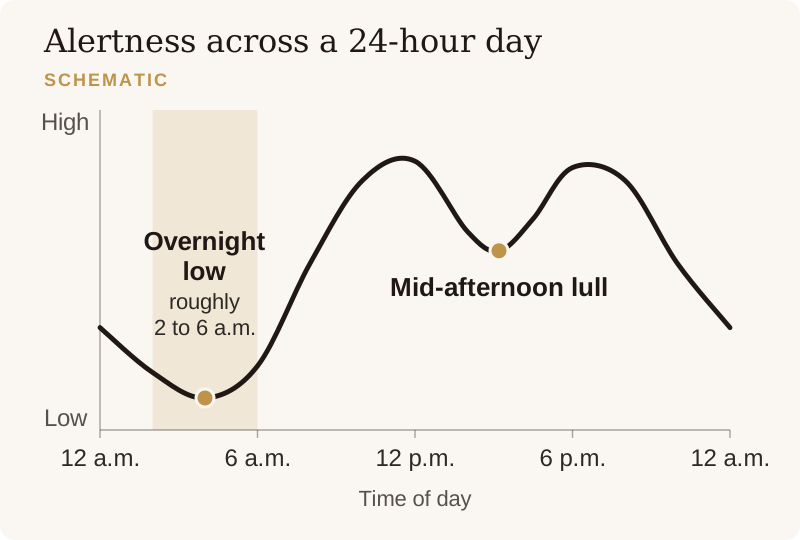
Two dips matter most. The mid-afternoon lull often lands on the 3 p.m. meeting, a shift change or the drive home. The overnight low, roughly 2 to 6 a.m., matters for anyone working nights. Road-safety data show both: in UK data, sleep-related crashes peaked around 2 a.m., 6 a.m. and 4 p.m.[8] Road accident risk shows a clear daily rhythm, with a major peak around 3 a.m.[7] Again, that's road data.
We need to stop fighting our physiology and start working with it. In a German factory study, researchers adjusted shifts to workers' chronotype, their natural timing as an early bird, a night owl or something in between. In this small study, workers with the most extreme body clocks said they slept longer and better on workdays, and reported better well-being.[9]
What can employers do to improve employee productivity with sleep?
I'm not a management guy, and I'm not a union guy. I'm a science guy.
Every workplace is different, so start with a day in the life of your workforce. And I'll be honest: the goal isn't perfect sleep for everyone. It's the best sleep possible given the demands of the job.
How can I stop feeling tired at work?
Fighting the 3 p.m. slump? Don't push through. Work with your body clock: timing is something you can change.

Shift workers are a different case: planned naps in fatigue-risk zones (see our shift worker guidance). Otherwise, it's entirely up to you how far to take these. If you snore loudly, wake up gasping, or still feel exhausted with a steady sleep window, talk to your physician.
Frequently asked questions
How does lack of sleep affect work performance?
It can blunt attention and decision-making,[5][10] and sleep problems are linked to 1.62 times the risk of injury at work.[6]
Is being awake 17 to 19 hours really like being drunk?
On some performance tests, yes. After 17 to 19 hours awake, performance matched or fell below that at 0.05% blood alcohol.[2] After about 24 hours, on a coordination task, it matched roughly 0.08 to 0.10%.[3]
Is 6 hours of actual sleep enough to work well?
For most adults, no. The guidance is at least seven hours of actual sleep.[20] In one experiment, people limited to six hours or less in bed slid over two weeks while feeling only a little sleepier.[5]
How much does lack of sleep cost employers?
For companies, one study put it at about US$1,967 per employee a year (2010 study).[13] RAND estimated up to US$411 billion a year (2015 dollars) for the US economy and about C$27 billion for Canada.[1]
How can I stop feeling tired at work?
Protect a regular sleep window, get outdoor light early and keep caffeine early. Still exhausted? Talk to your physician or take the Free Sleep Assessment.
For organizations
Bring sleep science to your workforce
Education comes first. NEOS Performance offers workshops and sleep health programs that help your people understand why sleep matters, what gets in the way, and how to protect it, built around how your workplace actually runs.

About the author
Dr. Glenn J. Landry, PhD
Sleep and circadian rhythms scientist · Founder, NEOS Performance
Dr. Glenn J. Landry, PhD, is a sleep and circadian rhythms scientist with 30 years in sleep science, and the founder of NEOS Performance in Delta, BC. He came to this field honestly: he couldn't sleep, starting at 13. He earned his PhD at Simon Fraser University and completed a postdoctoral fellowship at the University of British Columbia, studying sleep, aging and cognition. He created the Surviving Shift Work® program. Today Dr. Landry and the NEOS team guide executives, shift workers, first responders and organizations toward Elite Sleep®, translating science for each person's lived experience.
More about Dr. Glenn J. Landry, PhD Sources (21)
- [1] Hafner M, Stepanek M, Taylor J, Troxel WM, van Stolk C. Why Sleep Matters: The Economic Costs of Insufficient Sleep. A Cross-Country Comparative Analysis. RAND Europe; 2016. (RAND reports all countries in US dollars at 2015 prices; Canada: US$21.4 billion (1.35% of GDP). NEOS converted this to Canadian dollars at the Bank of Canada's 2015 average exchange rate (1.2787 CAD per USD): about C$27.4 billion.) Hafner et al., 2016 (RAND)
- [2] Williamson AM, Feyer AM. Moderate sleep deprivation produces impairments in cognitive and motor performance equivalent to legally prescribed levels of alcohol intoxication. Occupational and Environmental Medicine. 2000;57(10):649–655. Williamson & Feyer, 2000 (journal)
- [3] Dawson D, Reid K. Fatigue, alcohol and performance impairment. Nature. 1997;388(6639):235. Dawson & Reid, 1997 (journal)
- [4] Elmenhorst D, Elmenhorst EM, Luks N, et al. Performance impairment during four days partial sleep deprivation compared with the acute effects of alcohol and hypoxia. Sleep Medicine. 2009;10(2):189–197. (Small study, 16 men.) Elmenhorst et al., 2009 (journal)
- [5] Van Dongen HP, Maislin G, Mullington JM, Dinges DF. The cumulative cost of additional wakefulness: dose-response effects on neurobehavioral functions and sleep physiology from chronic sleep restriction and total sleep deprivation. Sleep. 2003;26(2):117–126. Van Dongen et al., 2003 (PubMed)
- [6] Uehli K, Mehta AJ, Miedinger D, et al. Sleep problems and work injuries: a systematic review and meta-analysis. Sleep Medicine Reviews. 2014;18(1):61–73. Uehli et al., 2014 (journal)
- [7] Folkard S. Black times: temporal determinants of transport safety. Accident Analysis & Prevention. 1997;29(4):417–430. Folkard, 1997 (PubMed)
- [8] Horne JA, Reyner LA. Sleep related vehicle accidents. BMJ. 1995;310(6979):565–567. Horne & Reyner, 1995 (PubMed)
- [9] Vetter C, Fischer D, Matera JL, Roenneberg T. Aligning work and circadian time in shift workers improves sleep and reduces circadian disruption. Current Biology. 2015;25(7):907–911. (Small, non-randomized study in one factory.) Vetter et al., 2015 (PubMed)
- [10] Harrison Y, Horne JA. The impact of sleep deprivation on decision making: a review. Journal of Experimental Psychology: Applied. 2000;6(3):236–249. Harrison & Horne, 2000 (PubMed)
- [11] Yoo SS, Gujar N, Hu P, Jolesz FA, Walker MP. The human emotional brain without sleep: a prefrontal amygdala disconnect. Current Biology. 2007;17(20):R877–R878. (Small study; total sleep deprivation for one night.) Yoo et al., 2007 (journal)
- [12] Barnes CM, Lucianetti L, Bhave DP, Christian MS. "You wouldn't like me when I'm sleepy": leaders' sleep, daily abusive supervision, and work unit engagement. Academy of Management Journal. 2015;58(5):1419–1437. Barnes et al., 2015 (journal)
- [13] Rosekind MR, Gregory KB, Mallis MM, et al. The cost of poor sleep: workplace productivity loss and associated costs. Journal of Occupational and Environmental Medicine. 2010;52(1):91–98. (Published January 2010.) Rosekind et al., 2010 (PubMed)
- [14] Ricci JA, Chee E, Lorandeau AL, Berger J. Fatigue in the U.S. workforce: prevalence and implications for lost productive work time. Journal of Occupational and Environmental Medicine. 2007;49(1):1–10. (Fatigue from any cause, not only sleep loss.) Ricci et al., 2007 (PubMed)
- [15] Kessler RC, Berglund PA, Coulouvrat C, et al. Insomnia and the performance of US workers: results from the America Insomnia Survey. Sleep. 2011;34(9):1161–1171. (Funded by Sanofi-Aventis.) Kessler et al., 2011 (PubMed)
- [16] Khubchandani J, Price JH. Short sleep duration in working American adults, 2010–2018. Journal of Community Health. 2020;45(2):219–227. (Funded by Merck Research Laboratories.) Khubchandani & Price, 2020 (PubMed)
- [17] Barnes CM, Wagner DT. Changing to daylight saving time cuts into sleep and increases workplace injuries. Journal of Applied Psychology. 2009;94(5):1305–1317. Barnes & Wagner, 2009 (journal)
- [18] Lerman SE, Eskin E, Flower DJ, et al. Fatigue risk management in the workplace (ACOEM guidance statement). Journal of Occupational and Environmental Medicine. 2012;54(2):231–258. Lerman et al., 2012 (journal)
- [19] Bostock S, Luik AI, Espie CA. Sleep and productivity benefits of digital CBT for insomnia: a randomized controlled trial conducted in the workplace environment. Journal of Occupational and Environmental Medicine. 2016;58(7):683–689. (The authors are affiliated with Big Health, which makes the program tested; the senior author co-founded it.) Bostock et al., 2016 (PubMed)
- [20] Watson NF, Badr MS, Belenky G, et al. Recommended amount of sleep for a healthy adult: a joint consensus statement of the American Academy of Sleep Medicine and Sleep Research Society. Journal of Clinical Sleep Medicine. 2015;11(6):591–592. Watson et al., 2015 (journal)
- [21] Brooks A, Lack L. A brief afternoon nap following nocturnal sleep restriction: which nap duration is most recuperative? Sleep. 2006;29(6):831–840. Brooks & Lack, 2006 (journal)