The Benefits of a Personalized Sleep Coach for Adults

Dr. Glenn J. Landry, PhD · Sleep and circadian rhythms scientist
Updated
· 14 min read

The short version
You already know you aren't getting the sleep you need. A sleep coach helps you figure out why, and charts your path toward Elite Sleep®: a plan built around your body clock, schedule and life, adjusted for you over time. One-size-fits-all approaches lack impact, because we're all individuals. Some of us are night owls, some of us are early birds, and many of us are somewhere in between. In my experience, giving everyone the same advice can do more harm than good.
Think of a coach as your guide. A coach doesn't diagnose or treat, and when something looks medical, your coach directs you to your primary care provider or physician. Sleep coaching is a new and growing field with great potential to help, but it's still in its infancy, and technology is helping it become what it can be. That's why this article is honest about what we know and what we don't. At NEOS, we have two goals: to change the way the world prioritizes sleep, and to give everyone access to the science of sleep, applied to their own lived experience.
Key takeaways
- In a 2014 CDC survey, more than 1 in 3 US adults said they usually sleep under 7 hours.[1] In Canadian survey data, about a third slept less than recommended.[2]
- We misjudge our own sleep: in one study, people overestimated it by about 50 minutes on average.[3]
- For chronic insomnia, the American College of Physicians recommends cognitive behavioral therapy for insomnia (CBT-I) first.[4]
- Sleep-hygiene tips on their own aren't recommended as a treatment for chronic insomnia.[5]
- Your wearable can tell you what happened to your sleep last night. We tell you what to do about it.
Timing is everything. But why?
We all know what we need to do: eat right, exercise and get plenty of sleep. So why is it so hard? Here's what most people don't realize: when you do these things matters as much as what you do. I'd argue it matters more. Timing is everything. That's why we're more than sleep coaches. We're sleep and circadian rhythms specialists, and we'll help you find the timing that works best for you.
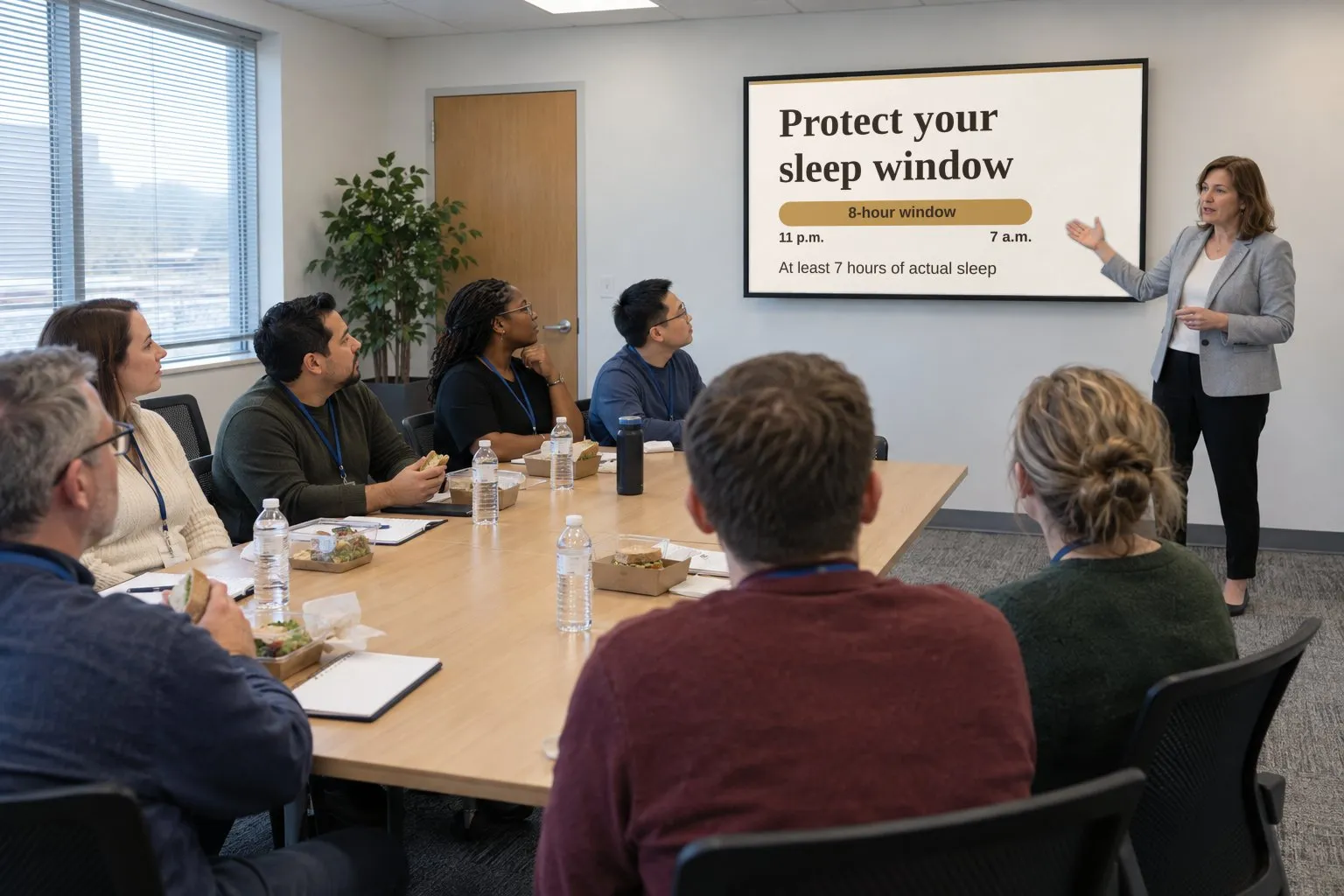
Here's the line I come back to again and again. Build a sleep window. Protect it with what you do during the day, and with what you do at night when you can't sleep. Do those two things, and let your sleep accountant balance the books. Your sleep accountant is what I call the process that keeps track of the sleep your body needs. Build the window, and let your sleep accountant fill it with the sleep you need.
Can a pill or supplement give you the sleep you need?
Many people are so desperate for sleep that they'll try supplements and sleep aids.
Here's how I explain it in our coaching. We're born able to get the sleep we need. Your sleep accountant tracks your prior sleep history and the kind of day you've had. No two days are the same. Some bring a ton of new learning. Some are incredibly stressful. Some are physically demanding. So the mix of sleep you need changes night after night.
That's physiological sleep. What I call pharmacological sleep is different. A drug or supplement meant to give you more deep sleep, or more REM, drives your sleep architecture, the pattern of your sleep stages, for you. It's like handcuffing your sleep accountant.
Your job is to un-handcuff it: build a sleep window and protect it, during the day and at night when you can't sleep. Then your sleep accountant can choose the sleep that balances the books.
I don't recommend melatonin or sleep medications as a fix. If you're using them, talk to your physician before changing anything.
What should you do when you can't sleep?
Awake in bed, worrying about tomorrow? In my coaching, I explain that this worry drives a stress response.
So protect your sleep window at night, too. I want you to avoid bright light, stimulating activity, stress and food. I call these time cues: they tell your body it's day, when it should be your sleep window.
Those cues don't only affect tonight. In my experience, they shape your sleep on future nights too, night after night.
Waking at 2 a.m. every night? I call that a weakened sleep maintenance zone, and the time cues we give it can reinforce it. If you wake often, or you snore loudly or gasp, see the red flags below and talk to your primary care provider or physician.
What does a personalized sleep coach actually do?
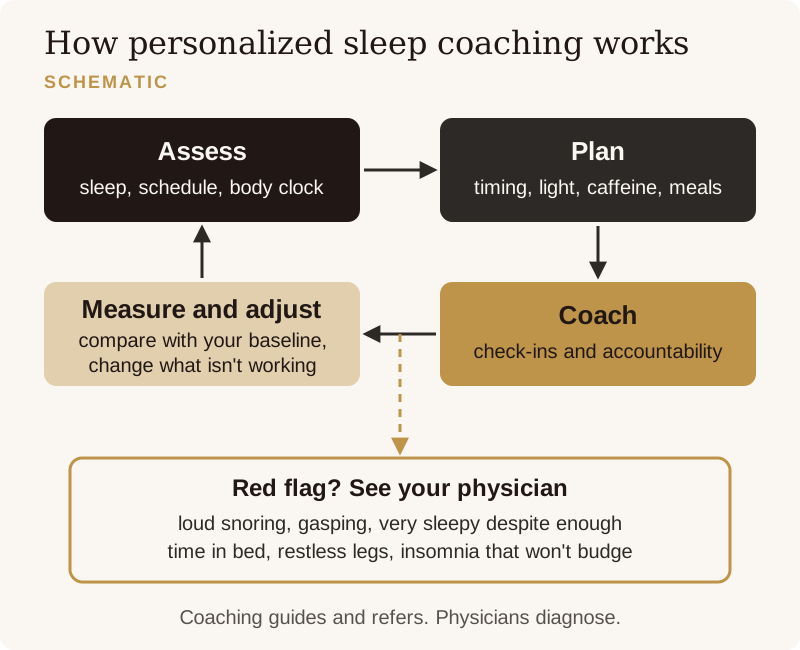
Here's what working with a sleep coach looks like. A coach guides you to understand your own sleep and change what you can. It isn't treatment. I'm a PhD, not an MD, and my lane is rhythms and sleep. The method is mine, not a study finding:
- Assess. We start with a questionnaire, then about a month of wearable data. Your sleep varies from week to week as well as night to night. I don't want you to study for the test. Just live your life, so the data shows your real sleep. Then we look past the hours to your sleep architecture, as your wearable estimates it, including how quickly you reach deep sleep.
- Plan. Together we plan the timing of light, caffeine, meals and exercise, breaks from sitting, and one consistent sleep window, built around your chronotype: your natural timing as an early bird, a night owl or something in between.
- Coach. Regular check-ins, so the plan fits your real life: the late meeting, the trip away.
- Measure and adjust. We compare with your baseline, and change what isn't working.
- Refer. If something looks like a sleep disorder, we direct you to your primary care provider or physician.
Why don't generic sleep tips work for everyone?
You've probably tried the tips: no screens, a cool room, no late coffee. If nothing worked, you're not broken. For chronic insomnia, the American Academy of Sleep Medicine recommends cognitive behavioral therapy for insomnia (CBT-I), and suggests clinicians not use sleep hygiene, those everyday tips, as a single-component therapy.[5] That is about treating chronic insomnia. It isn't a verdict on healthy habits.
Here's the thing: we all differ. Across 53,689 Americans, chronotype followed a near-normal distribution, shifting later through the teens, latest at about age 19, and earlier after that.[7] Genes play a part. In 85,760 people who wore activity monitors, the 5% with the most "morning" gene variants slept 25 minutes earlier, on average, than the 5% with the fewest.[8] Your best timing is partly your genes, partly how you live, and it changes over the years. That's one reason I think about your sleep across your whole lifespan, not just today.
“The truth is that one-size-fits-all approaches are much, much less impactful. We need to translate science for an individual's lived experience, so they can apply it in a meaningful way.”
Night owl, early bird or in between: why can the same advice backfire?
Take the popular advice to get morning light first thing. In my coaching, it often helps a night owl, someone who struggles to fall asleep and to wake. For an early bird, someone who falls asleep early and wakes too early, early light can make an existing problem worse.
And if you're not sure whether you're a night owl or an early bird? Here's a simple rule I use: if you don't know, you're probably neither. You're somewhere in between, and the advice you need is different again.
The science fits the night-owl half of this: after a week of camping in natural light only, later chronotypes showed larger body-clock shifts toward earlier timing, in a very small summer study (eight people).[9] More on circadian rhythms.

Why can't you just judge your own sleep?
Maybe you tell yourself "I sleep fine," and then wonder why you're always tired. Both can be true. In a Chicago study of 669 middle-aged adults, sleep measured by a wrist sensor averaged 6 hours, while self-reports averaged 6.8. The authors' model suggested that people sleeping 5 hours over-reported by 1.2 hours.[3]
Here's the sneaky part: short sleep hides itself. Healthy adults kept to 4 or 6 hours in bed a night for two weeks built up thinking deficits equivalent to up to two nights of total sleep deprivation. Their sleepiness ratings suggest they were largely unaware.[11] I hear it all the time: "Glenn, I can function really well on five hours." I'm sorry. You may feel like you're great, but you aren't your best self when you're sleep deprived.
Can my sleep tracker do the job for me?
A tracker gives you data, not decisions. Your wearable can tell you what happened to your sleep last night. We tell you what to do about it. We use the tech as a tool, but it's only the first step in figuring out how to actually improve your sleep, based on your lived experience.
None of them are perfect, and they aren't all equal. The good ones give what I call coachable data: accurate enough that we can make coaching decisions from it. And go easy on chasing a perfect score. One clinical commentary described patients seeking treatment for "self-diagnosed" sleep problems based on tracker data, and warned it may become "a perfectionistic quest for the ideal sleep".[12]
Want the data? Get an Advanced Sleep Assessment →
What are the benefits of working with a sleep coach? What the nearest research shows
Here's the honest picture. The strongest evidence is for guided behavioral treatment of insomnia, which clinicians deliver. That isn't coaching, and I won't pretend it is.
- Individual instructions plus follow-up helped. In a trial of 79 older adults with chronic insomnia, two sessions and two phone calls with individualized instructions from a nurse clinician led to a response in 67%, against 25% with printed information. The gains held at 6 months.[13]
- Remote can work too. In an analysis of 52 trials, every CBT-I setting, telehealth and in-person included, beat a waitlist, and no setting was found superior to another (corrected in 2025).[14][15] A larger analysis of 241 trials found in-person, therapist-led programs had the edge, though its authors caution that undetected interactions could undermine the conclusions.[6]
- Better sleep went with better mood. In a meta-analysis of 65 randomized trials (8,608 people), interventions that improved sleep also improved depression and anxiety, with medium-sized effects. These were sleep interventions in general, not coaching.[16]
Does "sleep coaching" itself work?
Sleep coaching is a new and growing field, still in its infancy, so the studies are newer and smaller. Here's what exists:
- A German Armed Forces trial of a four-session group program, registered as a sleep-coaching program, randomized 63 people to take the program now or later. Sleep measures improved with medium or large effects in both groups, and the waiting group also took the program, so there was no untreated comparison at the end. It was a group program, not one-to-one.[17]
- A four-week pilot trial of 59 university students compared peer coaching plus a Q&A tool with the Q&A tool alone. Sleep quality scores didn't differ significantly; wearable-measured sleep time was about 32 minutes longer with coaching.[18]
Then there's follow-through. Across 18 studies of technology-delivered insomnia treatment, about half the exercises weren't done. In interviews, users still believed they were sticking with it quite well.[19] In my experience, that's where a guide checking in with you helps.
“I can't walk that journey for you. But I can walk it with you. And that's what coaching does.”
Sleep coach, CBT-I or sleep doctor: which do you need?
Think of three lanes:
- A sleep coach guides you on habits, timing, body-clock alignment and accountability. A coach doesn't diagnose or treat.
- A CBT-I clinician treats chronic insomnia. The American College of Physicians recommends that all adults with chronic insomnia disorder receive cognitive behavioral therapy for insomnia (CBT-I) as the initial treatment (a strong recommendation, based on moderate-quality evidence).[4]
- A physician or sleep clinic is where to start with red flags: loud snoring, choking or gasping at night, feeling very sleepy despite enough time in bed, restless legs, insomnia that won't budge, or any question about medication or supplements. Talk to your primary care provider or physician.
These lanes work together. I'm big on team-based care: if you're already seeing a physician or a CBT-I clinician, we work alongside them, never instead of them.
Where you start is entirely up to you.
Why does protecting your sleep matter for the long run?
We've known for decades that sleep changes as a normal part of aging.[21] In a meta-analysis of 65 studies of healthy people aged 5 to 102, sleep efficiency and the share of deep (slow-wave) sleep fell with age in adults, though how strongly depended on how carefully participants were screened for health problems. But normal doesn't necessarily mean healthy. If the goal is healthspan, not just longevity but quality of life into our later years, I'd argue we must protect our sleep. I like to think in terms of what I call sleep health status. It isn't just today. It's throughout your lifespan.
Who can a personal sleep coach help?
- You're a busy professional or executive with long days and big decisions. See sleep coaching for executives and entrepreneurs.
- You're a woman in midlife. In a trial of 106 perimenopausal and postmenopausal women aged 40 to 65 with insomnia and hot flashes, six phone sessions of CBT-I over 8 weeks lowered Insomnia Severity Index scores by 9.9 points, against 4.7 for a menopause education group.[20] That was CBT-I, not coaching, and it didn't reduce hot flashes more than the education sessions did. See sleep coaching for perimenopausal women.
- You're an athlete, and your sleep has to fit around training and travel. See sleep coaching for high-performance athletes.
- You're a night owl, an early bird or somewhere in between, stuck with a schedule that doesn't suit you. I came to this field honestly, because I couldn't sleep. It began when I was 13.
- You work shifts or respond to emergencies. Within any shift system there are ways to adapt, and the goal is being fit for duty on the best sleep the job allows. See the best sleep schedule for night shift workers, shift workers, first responders and the Surviving Shift Work® course.
Where are you on your journey to Elite Sleep®?
We're all individuals, and we're all on a journey toward Elite Sleep®, just at different stages. Our job at NEOS Performance is to meet you wherever you are. As I always say, when the student is ready, the teacher will come. Some clients love data: they're happy to share lots of it and dig into the science. Others just want to know what to do, without all the science behind it. Both are fine. Our job is to find out what you want and help you get there. It's your goal, not ours.
We're data-driven, and it's a learning process. We suggest a change, then watch your data to see whether it's moving you in the right direction. If it isn't, we course-correct. Say light at night seems to be cutting into your deep sleep. We might suggest blue blocking in the evening. If your deep sleep goes up, we know we're on the right track. Your data lights the path toward Elite Sleep®.
It isn't 'you must get 90 minutes of deep sleep every night.' It's: where are you on your journey, and how far do you want to go?
How do you choose a sleep coach, and what can you expect from NEOS?
WebMD's consumer overview, written mainly about children's sleep coaches, notes there is no standardized certification system for sleep coaches. So ask about background and experience.[22]
Here's how we'd walk it together, and you can stop at any step. Start with the free sleep assessment, which takes about 5 to 10 minutes. Next, an Advanced Sleep Assessment looks at your own wearable data, and we tell you what to do about it. If you want one-to-one help, there's premium sleep coaching, a higher level of care. We can't promise you an outcome. We can walk the journey with you.
“The technical stuff was interesting but the access to Glenn was the most valuable part including his availability and a sense of accountability that I felt in ensuring I was doing my part.”
Frequently asked questions
What does a sleep coach do for adults?
A sleep coach guides you through your sleep: assessing your sleep, schedule and chronotype, building a plan around your body clock and life, adjusting it with you over time, and directing you to your primary care provider or physician if a sleep disorder is suspected. A coach doesn't diagnose or treat.
Is a sleep coach worth it?
It depends on the problem. Cognitive behavioral therapy for insomnia (CBT-I) is the recommended first treatment for chronic insomnia,[4] but studies of programs called "sleep coaching" are newer and smaller.[17][18] A coach may suit you if you've tried the tips and want accountability. Start with the free sleep assessment.
Should I see a sleep coach or a sleep doctor?
See your primary care provider or physician first if you snore loudly, choke or gasp at night, feel very sleepy despite enough time in bed, or have restless legs or insomnia that won't budge. A coach complements medical care and directs you to it. A coach doesn't replace it.
Can a sleep tracker replace a sleep coach?
A tracker gives you data, not decisions. Your wearable tells you what happened when you slept. A coach tells you what to do about it. People tend to overestimate their own sleep,[3] and chasing a perfect score can backfire.[12] A coach turns the data into a plan and checks in on it. Want the data? Try an Advanced Sleep Assessment.
How much does a sleep coach cost?
It varies, from a single assessment to a multi-week one-to-one program. See the Advanced Sleep Assessment and premium sleep coaching pages, or start with the free sleep assessment.
For individuals
Find out where your sleep stands
Start with the free sleep assessment. If you want the data, an Advanced Sleep Assessment looks at your own wearable data, and we tell you what to do about it. When you're ready for one-to-one help, premium sleep coaching is a higher level of care: we build a plan around your body clock and your life, and walk it with you.

About the author
Dr. Glenn J. Landry, PhD
Sleep and circadian rhythms scientist · Founder, NEOS Performance
Dr. Glenn J. Landry, PhD, is a sleep and circadian rhythms scientist with over 30 years in sleep science, and the founder of NEOS Performance in Delta, BC. He came to this field honestly: he couldn't sleep, starting at 13. He earned his PhD at Simon Fraser University and completed a postdoctoral fellowship at the University of British Columbia, studying sleep, aging and cognition. He created the Surviving Shift Work® program. Today Dr. Landry and the NEOS team guide executives, shift workers, first responders and organizations toward Elite Sleep®, translating science for each person's lived experience.
More about Dr. LandrySources
- [1] Liu Y, Wheaton AG, Chapman DP, et al. Prevalence of healthy sleep duration among adults: United States, 2014. MMWR Morbidity and Mortality Weekly Report. 2016;65(6):137–141. (444,306 adults in the 2014 BRFSS survey; "healthy" = 7 or more hours; self-reported.) View source
- [2] Chaput JP, Wong SL, Michaud I. Duration and quality of sleep among Canadians aged 18 to 79. Health Reports. 2017;28(9):28–33. (10,976 adults, 2007–2013; self-reported. "About a third slept fewer hours than recommended.") View source
- [3] Lauderdale DS, Knutson KL, Yan LL, Liu K, Rathouz PJ. Self-reported and measured sleep duration: how similar are they? Epidemiology. 2008;19(6):838–845. (669 middle-aged adults at the Chicago site of the CARDIA study; measured with wrist actigraphy.) View source
- [4] Qaseem A, Kansagara D, Forciea MA, Cooke M, Denberg TD. Management of chronic insomnia disorder in adults: a clinical practice guideline from the American College of Physicians. Annals of Internal Medicine. 2016;165(2):125–133. View source
- [5] Edinger JD, Arnedt JT, Bertisch SM, et al. Behavioral and psychological treatments for chronic insomnia disorder in adults: an American Academy of Sleep Medicine clinical practice guideline. Journal of Clinical Sleep Medicine. 2021;17(2):255–262. View source
- [6] Furukawa Y, Sakata M, Yamamoto R, et al. Components and delivery formats of cognitive behavioral therapy for chronic insomnia in adults: a systematic review and component network meta-analysis. JAMA Psychiatry. 2024;81(4):357–365. (241 trials, 31,452 adults. The authors note that potential undetected interactions could undermine the conclusions. One co-author teaches CBT-I, writes CBT-I manuals and is a founder of Hypknowledge, LLC.) View source
- [7] Fischer D, Lombardi DA, Marucci-Wellman H, Roenneberg T. Chronotypes in the US: influence of age and sex. PLoS One. 2017;12(6):e0178782. (53,689 Americans.) View source
- [8] Jones SE, Lane JM, Wood AR, et al. Genome-wide association analyses of chronotype in 697,828 individuals provides insights into circadian rhythms. Nature Communications. 2019;10:343. (UK Biobank and 23andMe participants. The 25-minute sleep-timing difference comes from the 85,760 people with activity-monitor data.) View source
- [9] Wright KP Jr, McHill AW, Birks BR, et al. Entrainment of the human circadian clock to the natural light-dark cycle. Current Biology. 2013;23(16):1554–1558. (Very small study: eight participants; one summer week of camping. It supports the night-owl half of the morning-light point only.) View source
- [10] Watson NF, Badr MS, Belenky G, et al. Recommended amount of sleep for a healthy adult: a joint consensus statement of the American Academy of Sleep Medicine and Sleep Research Society. Sleep. 2015;38(6):843–844. (Recommendation wording: "seven or more hours of sleep per night", from the AASM statement page.) View source
- [11] Van Dongen HP, Maislin G, Mullington JM, Dinges DF. The cumulative cost of additional wakefulness: dose-response effects on neurobehavioral functions and sleep physiology from chronic sleep restriction and total sleep deprivation. Sleep. 2003;26(2):117–126. (48 healthy adults, laboratory study.) View source
- [12] Baron KG, Abbott S, Jao N, Manalo N, Mullen R. Orthosomnia: are some patients taking the quantified self too far? Journal of Clinical Sleep Medicine. 2017;13(2):351–354. (A clinical commentary based on patient cases, not a prevalence study.) View source
- [13] Buysse DJ, Germain A, Moul DE, et al. Efficacy of brief behavioral treatment for chronic insomnia in older adults. Archives of Internal Medicine. 2011;171(10):887–895. (79 older adults, mean age 71.7; both groups were seen by a nurse clinician.) View source
- [14] Simon L, Steinmetz L, Feige B, Benz F, Spiegelhalder K, Baumeister H. Comparative efficacy of onsite, digital, and other settings for cognitive behavioral therapy for insomnia: a systematic review and network meta-analysis. Scientific Reports. 2023;13:1929. (52 randomized trials. Cite the corrected figures: the original abstract on PubMed still shows the figures before the 2025 correction.) View source
- [15] Simon L, Steinmetz L, Feige B, Benz F, Spiegelhalder K, Baumeister H. Author correction: comparative efficacy of onsite, digital, and other settings for cognitive behavioral therapy for insomnia. Scientific Reports. 2025;15:16827. (After correction: all examined settings beat the waitlist, and neither of the CBT-I settings was superior to another.) View source
- [16] Scott AJ, Webb TL, Martyn-St James M, Rowse G, Weich S. Improving sleep quality leads to better mental health: a meta-analysis of randomised controlled trials. Sleep Medicine Reviews. 2021;60:101556. (65 trials, 8,608 participants; sleep interventions in general, not coaching specifically.) View source
- [17] Sauter C, Kowalski JT, Stein M, Röttger S, Danker-Hopfe H. Effects of a workplace-based sleep health program on sleep in members of the German Armed Forces. Journal of Clinical Sleep Medicine. 2019;15(3):417–429. (63 randomized; four weekly group sessions; the waiting-list group took the program afterwards; registered as the "Development and Evaluation of a Sleep-coaching Program".) View source
- [18] Liu J, Ito S, Ngo TM, et al. A pilot randomised controlled trial exploring the feasibility and efficacy of a human-AI sleep coaching model for improving sleep among university students. Digital Health. 2024;10:20552076241241244. (Pilot; 59 students; four weeks; not blinded.) View source
- [19] Horsch C, Lancee J, Beun RJ, Neerincx MA, Brinkman WP. Adherence to technology-mediated insomnia treatment: a meta-analysis, interviews, and focus groups. Journal of Medical Internet Research. 2015;17(9):e214. (Adherence of about 52% is from a meta-analysis of 18 studies; the finding that users believed they adhered well is from 15 separate interviews.) View source
- [20] McCurry SM, Guthrie KA, Morin CM, et al. Telephone-based cognitive behavioral therapy for insomnia in perimenopausal and postmenopausal women with vasomotor symptoms: a MsFLASH randomized clinical trial. JAMA Internal Medicine. 2016;176(7):913–920. (106 women aged 40 to 65; CBT-I, not coaching.) View source
- [21] Ohayon MM, Carskadon MA, Guilleminault C, Vitiello MV. Meta-analysis of quantitative sleep parameters from childhood to old age in healthy individuals: developing normative sleep values across the human lifespan. Sleep. 2004;27(7):1255–1273. (65 studies, 3,577 people aged 5 to 102. In adults, sleep efficiency and the percentage of slow-wave sleep decreased with age; the authors note effect sizes depended on how carefully participants were screened for health problems.) View source
- [22] Selemin J. What is a sleep coach? WebMD; medically reviewed by Shruthi N, MD, 30 Aug 2024. (Consumer page, mainly about children's sleep coaches. Used only for the point that there is no standardized certification.) View source