The Best Sleep Schedule for Night Shift Workers

Dr. Glenn J. Landry, PhD · Sleep and circadian rhythms scientist
Updated · 12 min read

The short version
The best sleep schedule for night shift workers keeps your body clock anchored to the day and manages the night, instead of trying to flip onto nights. Fewer than 3% of permanent night workers fully adjust.[1] I want you to nap before your first night, protect a long daytime sleep between nights, and take a short, alarmed sleep after your last night, so you can sleep at your normal bedtime.
Here's the thing. No single clock time fits every night, because what you need changes across your block. Even in the lab, no one way of timing sleep between nights clearly won.[2] What matters most is protecting the time. Here's your block, night by night.
Key takeaways
- Your first night is usually your sleepiest, so nap that afternoon.[5]
- Block blue light early in the shift. In the 2 to 6 a.m. danger zone, use bright light as needed, not more caffeine, and nap whenever it's safe.
- Between nights, have breakfast first, then sleep through the afternoon lull.
- Get bright light before you drive home,[18] and never wear blue-blocking glasses behind the wheel.
- After your last night, sleep for about three and a half hours, then stay up until your normal bedtime.
Why does your body clock fight the night shift?
Shift work and sleep pull in opposite directions. Most people treat the graveyard shift as a scheduling problem: change your hours, change your sleep. Your body doesn't see it that way. Circadian rhythms are daily biological rhythms of physiology and behavior. We all have them, and light sets them.
In a review of six studies of permanent night workers, fewer than 3% fully adjusted their melatonin rhythm, a marker of the body clock.[1] The sun, your family and your days off keep pulling you back. So I teach the opposite: stay day.
What holds the clock steady is an anchor: a protected sleep window you keep on day shifts and days off. In a small 1981 isolation-unit study, keeping one 4-hour block of sleep at the same time each day, while the other 4 hours moved around, settled volunteers onto a 24-hour rhythm.[3] In the example below, someone whose day shift starts at 7 a.m. gets up at 5:30, so the anchor is 9:30 p.m. to 5:30 a.m.
What is the best sleep schedule for night shift workers?
It's not just what you do that matters, it's when you do it, and the right schedule changes across your block. I teach one idea:
“We need to take the shift out of shift work, and what we need to do is stay day… We can take the shift out of shift work and we can stay day.”
Here's a whole block on a common roster: two 12-hour days, two 12-hour nights, four days off. Nights run 7 p.m. to 7 a.m. Your shift system and times may differ; the principles are the same.
- Days 1–2, day shifts: sleep 9:30 p.m. to 5:30 a.m.
- Day 3, first night: usual wake time, as much morning light as you can get (on these days I double my usual hour to two), a nap in the afternoon lull, dinner before you leave.
- Night 1: coffee early, blue blockers on inside for the first part of the shift, bright light as needed in the danger zone, a nap whenever it's safe, and bright light before the drive home.
- Day 4, between nights: breakfast, light and a little activity, then sleep about 10 a.m. to 4:30 p.m., through the afternoon lull. Skip lunch; dinner before night 2.
- Day 5, after your last night: about three and a half hours of alarmed sleep, then up until bed.
- Days 6–8, days off: back on your anchor window. Protect your wake time.
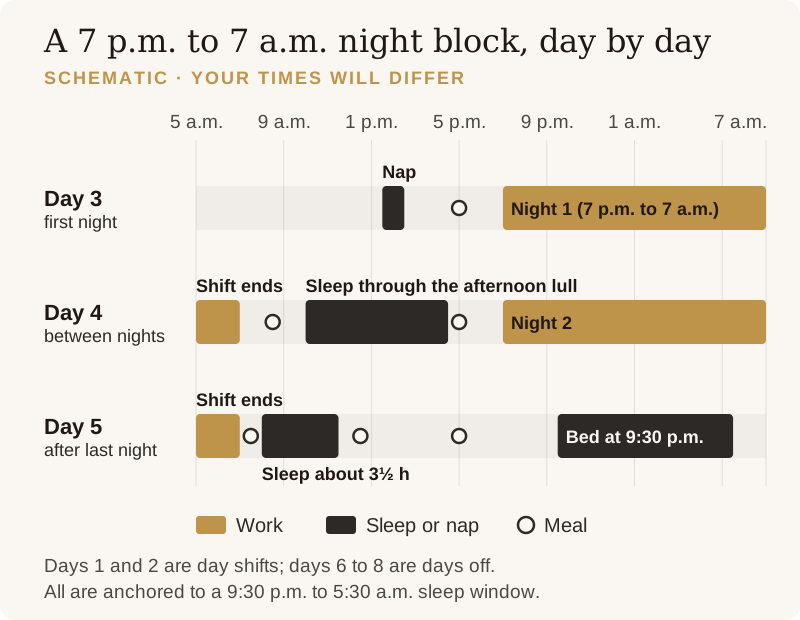
In this example, six of every eight days, the two day shifts and the four days off, stay anchored to the day, so your clock has less distance to come back. Whatever your shift system, the idea is the same: anchor to the day whenever you can, and use the night-shift tools when you can't.
Meals are a time cue too, especially for the clocks in your organs.[4] I teach that those clocks anchor to your biggest meals, so I recommend a big breakfast, a good-sized lunch and a smaller dinner, and as little food as possible on nights.
Should you nap before your first night shift?
Yes. It's the most important nap of your roster, because your first night is usually your sleepiest. It boosts your system and prepares it in advance of the challenge. A 2026 meta-analysis found sleepiness peaked on the first night of a block, then fell (13 studies looked at nights in a row).[5]
In a lab study, a nap before night shifts improved alertness, and a nap plus coffee worked best.[6] In police drivers, a nap was estimated, by a model, to roughly halve night crash risk.[7]
How long? There isn't a set length. Use the afternoon lull, your clock's mid-afternoon dip in alertness, and take what you can get. Even a 10-minute nap can help: in a lab study, a 10-minute afternoon nap improved alertness and performance right away.[29] As I teach it, that can be protective. Leave time to shake off the grogginess before you drive.
Don't count on sleeping just before you leave. The early evening, the few hours before your usual bedtime, is your clock's wake maintenance zone, when it pushes hardest for wakefulness.[8] The afternoon lull is your window.
"I'll sleep in so I'm rested." I'm sorry, but that tells your clock the day started late. Get up at your usual time, take morning light, and put the extra rest in the afternoon lull.
How do you stay alert early in a night shift?
Early in the shift, light pushes your clock later.[28] That's exactly the shift we want to take out of shift work. Once you're inside, I want you to put on good blue-blocking glasses. In a simulated night shift, they didn't hurt performance or alertness.[11] No study has tested my exact approach yet. Put them on after you park. Never in the car. If your work depends on seeing colors accurately, talk to your employer first.
What helps in the 2 to 6 a.m. danger zone?
Then comes the danger zone, roughly 2 to 6 a.m. The lights are on and nobody's home. After 17 to 19 hours awake, people did some tests as poorly as, or worse than, at 0.05% blood alcohol.[9][10] Timing makes it worse: these comparisons were made late at night and into the early-morning hours, toward the low point of the body clock,[9][10] which is also when road-crash risk peaks.[12]
You can't tough this out, so glasses off, and use your tools:
- Bright light, as needed. I use a blue-enriched light box: in my experience, 20 to 40 minutes gives an alerting boost that lasts a while. Use it when you need to be sharp or doing safety-critical work, not all night, because light at this hour can also shift your clock. Turn it off when you get a chance to nap. If you have an eye condition or bipolar disorder, or take medication that makes you sensitive to light, check with your physician before using a light box. Trials in shift workers are small and low quality.[13]
- Nap whenever it's safe to do so, within company policy and guidelines. Nighttime is the right time for naps, and there isn't a set length. Even a 10-minute nap can help: in a lab study, a 10-minute afternoon nap improved alertness and performance right away.[29] As I teach it, before the drive home that can be protective. If you don't take a safe chance, your system may choose an unsafe one. Sleep intrusions are involuntary. Sleep for as long as you can and still get the job done. Pooling 18 studies, mostly in the lab, naps improved performance on average;[14] the benefit showed up about 30 minutes after waking, so give yourself time, light and movement before you drive.
- Caffeine can help attention.[15] I suggest having it early in the shift, not late, so it's wearing off by the time you sleep. In the danger zone, reach for light, not more caffeine.
- Little or no food. At 3 a.m., you're often not hungry, you're tired. If you must eat, keep it small and easy to digest. Night eating worsened blood-sugar control in a lab.[16] If you have diabetes or another medical condition, talk to your physician before changing when you eat.
How do you get home safely after a night shift?
As I tell every shift worker I teach: you aren't really off shift until you're home. Come to work fit for duty, and make it home safe. You leave with your biggest sleep debt of the day, and you've just relaxed. In a closed-track study, 16 night-shift workers drove after a shift. Six drives had near-crashes and seven were stopped early; after a night of sleep, none were.[17]
So here's a rule that never bends. Get bright light before you drive, keep it bright during the drive, and never wear blue-blocking glasses behind the wheel. Take them off before you get in the car. In a driving simulator, five of 19 people kept up all night had a serious crash after dim light. After bright light, none did (45 minutes of very bright light before the drive).[18] A small study, and they still felt sleepy, but it's an edge.
Heavy eyelids or drifting over the line? Pull over somewhere safe. Cold air on your face and the radio don't fix it.[19] A nap is your best tool: sleep 10 minutes, then walk around in the light before you drive on. Too tired to drive? Sleep at work first, carpool or take transit. That isn't weakness.
What sleep routine works between two night shifts?
Most of us go straight to bed after a night shift. Here's the problem: in the morning, your clock is already pushing you to be awake, and your alertness is climbing.[20] You only fall asleep because you're exhausted. In my experience, many people sleep about three hours, wake into the alert part of your morning, can't get back to sleep, and walk into night two short.

To be fair to the science: in a sleep lab, 12 young men slept straight away, later, or in two parts between two night shifts, and total sleep and next-night performance were about the same.[2] My approach works for many people I coach, but if going straight to bed works for you, it's entirely up to you. What matters is protecting the time.
How do you switch back to days after your last night?
Your last night decides how your days off go. You need to sleep tonight, in your normal window. Come home and sleep all day, and you'll be up all night.
My coaching method is a short, alarmed sleep: food, bed, and an alarm for about three and a half hours. Four is the ceiling. When it goes off, get up, get light, move, and hold on to your usual bedtime. You'll be tired that evening. That's the point.
Can't fall asleep? Stay up in the light until about 11 a.m., then sleep about three hours. This is my coaching method, and no study has tested it.
How many night shifts in a row is too many?
Where you have a say, fewer night shifts in a row are easier on your body clock, and safer. In a 2017 meta-analysis, injury risk rose with each night in a row, and by the fourth it was about a third higher than on the first.[21] Each night adds some sleep debt, and days off let you recover. Back-to-back nights add sleep debt on top of sleep debt.
Can't choose? Most people can't. Within any shift system, there are ways to adapt: run the same steps every night, and be stricter about the drive home. Planning rosters for a 24/7 team? Talk to us about fatigue-risk training.
When is it more than shift work?
Poor sleep on nights is common. Just because it's normal doesn't mean it's healthy, and it doesn't mean it's inevitable.
When problems persist, it may be shift work disorder, a specific diagnosis found in roughly 1 in 10 to 1 in 4 shift workers, depending on how it's measured.[23][24] Loud snoring, gasping awake or exhaustion that won't budge are reasons to talk to your physician. I'm a PhD, not an MD, and I don't recommend melatonin or sleep medications as a fix. If you're using them, talk to your physician before changing anything.
Not sure where to start? Start your free sleep assessment.
Frequently asked questions
Should I sleep before or after a night shift?
Both. Before your first night, which is usually the sleepiest,[5] nap in the afternoon lull. Between nights, I suggest breakfast, light, then sleep; in the lab, no timing clearly won.[2]
What sleep pattern do night shift workers need?
The same as anyone. My guidance is an eight-hour sleep window, to get at least seven hours of actual sleep. Seven hours of actual sleep is the consensus minimum for adults.[25] Many get far less: 44% of US night-shift workers in a 2010 CDC survey slept six hours or less a day.[22] Protect the main sleep first.
How do I switch back to days after my last night shift?
Sleep about three and a half hours with an alarm, then get light, move, and go to bed at your usual time.
What about evening shifts?
Take the shift out of those too. Nap before your shift, because you'll be working through your afternoon lull. In the last part of the shift, block blue light: those are the hours before your normal bedtime. Go to sleep when you get home, then get back to your day.
What if I work 24-hour shifts or a different rotation?
The same principles apply in any shift system. Anchor to the day whenever you can. Nap before a long shift, and on shift whenever it's safe to do so: nighttime is the right time for naps. Manage your light, keep night eating light, and protect the drive home. Sleep coaching can help you fit the details to your roster.
Should I nap before a night shift?
Yes, especially before your first night, which is usually the sleepiest.[5] On shift, nap whenever it's safe and your workplace allows. There isn't a set length. Even a 10-minute nap can help: in a lab study, a 10-minute afternoon nap improved alertness and performance right away.[29] As I teach it, before the drive home that can be protective. A nap plus coffee worked best in a lab study.[6]
Is working the night shift bad for your health?
Long-term shift work is linked with more heart disease: one analysis found coronary heart disease 26% higher in shift workers, and the risk of cardiovascular events rose about 7% for every five years of shift work after the first five.[26] The International Agency for Research on Cancer classes night shift work as probably carcinogenic, on limited human evidence.[27] This is education, not medical advice: talk to your physician.
For shift workers
Get the full night-shift playbook
The Surviving Shift Work® online course walks you through this plan step by step: 10 lessons, about 6½ hours of video, built for people who work nights, rotating shifts and long hours. Learn it at your own pace.

About the author
Dr. Glenn J. Landry, PhD
Sleep and circadian rhythms scientist · Founder, NEOS Performance
Dr. Glenn J. Landry, PhD, is a sleep and circadian rhythms scientist with 30 years in sleep science, and the founder of NEOS Performance in Delta, BC. He came to this field honestly: he couldn't sleep, starting at 13. He earned his PhD at Simon Fraser University and completed a postdoctoral fellowship at the University of British Columbia, studying sleep, aging and cognition. He created the Surviving Shift Work® program. Today Dr. Landry and the NEOS team guide executives, shift workers, first responders and organizations toward Elite Sleep®, translating science for each person's lived experience.
More about Dr. Glenn J. Landry, PhD Sources (29)
- [1] Folkard S. Do permanent night workers show circadian adjustment? A review based on the endogenous melatonin rhythm. Chronobiology International. 2008;25(2):215–224. (Six studies; oil-rig and remote-mine studies were excluded.) Folkard, 2008 (PubMed)
- [2] Sargent C, Kosmadopoulos A, Zhou X, Roach GD. Timing of sleep in the break between two consecutive night-shifts: the effect of different strategies on daytime sleep and night-time neurobehavioural function. Nature and Science of Sleep. 2022;14:231–242. (Small sleep-lab study: 12 men, aged about 23.) Sargent et al., 2022 (PubMed)
- [3] Minors DS, Waterhouse JM. Anchor sleep as a synchronizer of rhythms on abnormal routines. International Journal of Chronobiology. 1981;7(3):165–188. (Small isolation-unit study in volunteers, not shift workers.) Minors & Waterhouse, 1981 (PubMed)
- [4] Wehrens SMT, Christou S, Isherwood C, et al. Meal timing regulates the human circadian system. Current Biology. 2017;27(12):1768–1775.e3. (Lab study, 10 young men.) Wehrens et al., 2017 (PubMed)
- [5] Vieten L, Arlinghaus A, Sobisch M, Brenscheidt F, Fischer S, Gärtner J. Work schedule characteristics and sleepiness: a meta-analysis. Scandinavian Journal of Work, Environment & Health. 2026;52(2):110–124. Vieten et al., 2026 (PubMed)
- [6] Schweitzer PK, Randazzo AC, Stone K, Erman M, Walsh JK. Laboratory and field studies of naps and caffeine as practical countermeasures for sleep-wake problems associated with night work. Sleep. 2006;29(1):39–50. Schweitzer et al., 2006 (PubMed)
- [7] Garbarino S, Mascialino B, Penco MA, et al. Professional shift-work drivers who adopt prophylactic naps can reduce the risk of car accidents during night work. Sleep. 2004;27(7):1295–1302. (The roughly 50% figure is a theoretical estimate from a mathematical model.) Garbarino et al., 2004 (PubMed)
- [8] Strogatz SH, Kronauer RE, Czeisler CA. Circadian pacemaker interferes with sleep onset at specific times each day: role in insomnia. American Journal of Physiology. 1987;253(1 Pt 2):R172–R178. Strogatz et al., 1987 (PubMed)
- [9] Dawson D, Reid K. Fatigue, alcohol and performance impairment. Nature. 1997;388(6639):235. Dawson & Reid, 1997 (journal)
- [10] Williamson AM, Feyer AM. Moderate sleep deprivation produces impairments in cognitive and motor performance equivalent to legally prescribed levels of alcohol intoxication. Occupational and Environmental Medicine. 2000;57(10):649–655. Williamson & Feyer, 2000 (journal)
- [11] Kayumov L, Casper RF, Hawa RJ, et al. Blocking low-wavelength light prevents nocturnal melatonin suppression with no adverse effect on performance during simulated shift work. Journal of Clinical Endocrinology & Metabolism. 2005;90(5):2755–2761. (Simulated night shift, 19 people.) Kayumov et al., 2005 (PubMed)
- [12] Folkard S. Black times: temporal determinants of transport safety. Accident Analysis & Prevention. 1997;29(4):417–430. Folkard, 1997 (PubMed)
- [13] Slanger TE, Gross JV, Pinger A, et al. Person-directed, non-pharmacological interventions for sleepiness at work and sleep disturbances caused by shift work. Cochrane Database of Systematic Reviews. 2016;(8):CD010641. Slanger et al., 2016 (PubMed)
- [14] Dutheil F, Bessonnat B, Pereira B, et al. Napping and cognitive performance during night shifts: a systematic review and meta-analysis. Sleep. 2020;43(12):zsaa109. (18 studies, 494 people; the authors call for more real-workplace data.) Dutheil et al., 2020 (PubMed)
- [15] Ker K, Edwards PJ, Felix LM, Blackhall K, Roberts I. Caffeine for the prevention of injuries and errors in shift workers. Cochrane Database of Systematic Reviews. 2010;(5):CD008508. (13 trials, mostly young participants in simulated conditions.) Ker et al., 2010 (PubMed)
- [16] Chellappa SL, Qian J, Vujovic N, et al. Daytime eating prevents internal circadian misalignment and glucose intolerance in night work. Science Advances. 2021;7(49):eabg9910. (14-day lab study of simulated night work.) Chellappa et al., 2021 (PubMed)
- [17] Lee ML, Howard ME, Horrey WJ, et al. High risk of near-crash driving events following night-shift work. Proceedings of the National Academy of Sciences. 2016;113(1):176–181. (16 night-shift workers on a closed track.) Lee et al., 2016 (PubMed)
- [18] Weisgerber DM, Nikol M, Mistlberger RE. Driving home from the night shift: a bright light intervention study. Sleep Medicine. 2017;30:171–179. (Driving simulator, 19 young volunteers. Disclosure: the senior author, Dr. Ralph Mistlberger, supervised the PhD research of this article's author, Dr. Glenn J. Landry, PhD.) Weisgerber et al., 2017 (PubMed)
- [19] Reyner LA, Horne JA. Evaluation "in-car" countermeasures to sleepiness: cold air and radio. Sleep. 1998;21(1):46–50. Reyner & Horne, 1998 (PubMed)
- [20] Valdez P. Circadian rhythms in attention. Yale Journal of Biology and Medicine. 2019;92(1):81–92. Valdez, 2019 (PubMed)
- [21] Fischer D, Lombardi DA, Folkard S, Willetts J, Christiani DC. Updating the "Risk Index": a systematic review and meta-analysis of occupational injuries and work schedule characteristics. Chronobiology International. 2017;34(10):1423–1438. Fischer et al., 2017 (PubMed)
- [22] Centers for Disease Control and Prevention. Short sleep duration among workers: United States, 2010. Morbidity and Mortality Weekly Report. 2012;61(16):281–285. (2010 survey data.) CDC MMWR, 2012 (PubMed)
- [23] Drake CL, Roehrs T, Richardson G, Walsh JK, Roth T. Shift work sleep disorder: prevalence and consequences beyond that of symptomatic day workers. Sleep. 2004;27(8):1453–1462. (Detroit area; about 10% of night and rotating workers.) Drake et al., 2004 (PubMed)
- [24] Pallesen S, Bjorvatn B, Waage S, Harris A, Sagoe D. Prevalence of shift work disorder: a systematic review and meta-analysis. Frontiers in Psychology. 2021;12:638252. (29 studies; pooled estimate 26.5%, with very high variation between studies.) Pallesen et al., 2021 (PubMed)
- [25] Watson NF, Badr MS, Belenky G, et al. Recommended amount of sleep for a healthy adult: a joint consensus statement of the American Academy of Sleep Medicine and Sleep Research Society. Journal of Clinical Sleep Medicine. 2015;11(6):591–592. Watson et al., 2015 (journal)
- [26] Torquati L, Mielke GI, Brown WJ, Kolbe-Alexander T. Shift work and the risk of cardiovascular disease: a systematic review and meta-analysis including dose-response relationship. Scandinavian Journal of Work, Environment & Health. 2018;44(3):229–238. (21 studies, 173,010 people; covers shift work in general, not nights only.) Torquati et al., 2018 (PubMed)
- [27] IARC Monographs Vol 124 group. Carcinogenicity of night shift work. The Lancet Oncology. 2019;20(8):1058–1059. (Group 2A, "probably carcinogenic to humans": limited evidence in humans; sufficient evidence in experimental animals for alteration of the light–dark schedule; strong mechanistic evidence. The class describes the strength of the evidence, not the size of the risk.) IARC, 2019 (PubMed)
- [28] Khalsa SB, Jewett ME, Cajochen C, Czeisler CA. A phase response curve to single bright light pulses in human subjects. Journal of Physiology. 2003;549(Pt 3):945–952. (21 healthy people; 6.7-hour exposure of about 10,000 lux; peak-to-trough amplitude 5.02 hours; lab study.) Khalsa et al., 2003 (PubMed)
- [29] Brooks A, Lack L. A brief afternoon nap following nocturnal sleep restriction: which nap duration is most recuperative? Sleep. 2006;29(6):831–840. (24 healthy young good sleepers held to about five hours of sleep the night before; naps of 5, 10, 20 and 30 minutes tested.) Brooks & Lack, 2006 (journal)