The Impact of Personalized Sleep Coaching on Organizations

Dr. Glenn J. Landry, PhD · Sleep and circadian rhythms scientist
Updated · 9 min read
The short version
Sleep in the workplace isn't just a business issue. It's a bottom-line issue. Short sleep costs the US economy up to an estimated US$411 billion a year, and Canada up to about C$27 billion.[1] Workplace sleep programs can improve sleep, though the evidence is still weak.[10] In one randomized trial, firefighters offered sleep education, screening and referral had 46% fewer disability days over the study, even though their reported sleep didn't change.[13]
For companies, fatigue-related lost productivity was estimated at about US$1,967 per employee a year in a 2010 study.[2] The evidence is promising, but mostly short-term and often self-reported. A generic wellness program didn't move sleep. Targeted, expert-led, measured programs are worth your attention.
Key takeaways
- A large randomized trial of a typical workplace wellness program found no significant change in sleep quality or absenteeism after 18 months.[5]
- In fire departments, after expert-led sleep education, 41% of at-risk firefighters who answered a follow-up survey said they had sought an evaluation, against 20 to 25% with other delivery methods.[14]
- About 4 in 10 police officers screened positive for a sleep disorder, most of them undiagnosed, so personal assessment matters.[7]
- Measure it. Nobody can promise you a return, so track absence, presenteeism, incidents and sleep.
Why should organizations care about sleep in the workplace?
There's a mentality that sleep is a waste of productive time. Here's the thing. Tired people don't leave the payroll. They stay, and they're impaired. Researchers call it presenteeism: being at work but not working at your best. The lights are on, but nobody's home. And it isn't a choice.
Start with the economy. RAND estimated that insufficient sleep costs the US economy up to US$411 billion a year (2.28% of GDP, 2015 dollars), and Canada up to about C$27 billion (1.35% of GDP).[1] Those are upper estimates for a whole economy, not one company's bill.
Now the company. Fatigue-related lost productivity was estimated at about US$1,967 per employee a year in a 2010 study, across 4,188 employees at four US companies.[2] RAND also estimated that people sleeping under six hours lose around six more working days a year than people getting seven to nine hours of actual sleep.[1] Among 11,698 state employees, more trouble sleeping went with more absence, lower performance ratings and higher health-care costs.[3] That is an association, not proof of cause.
That's the bad news. Short sleep is common at work: about 3 in 10 US workers report six hours or less.[4] But just because it's normal doesn't mean it's healthy, and it doesn't mean it's inevitable. For the day-to-day productivity detail, see how sleep affects employee productivity.
Why don't generic wellness programs fix sleep?
A common answer is: "We already have a wellness program." I'm glad you do. But a program built around nutrition and exercise wasn't built for sleep.
One large trial makes the point. Researchers randomly assigned 160 worksites of a large US employer, 32,974 employees in all, to a wellness program (8 modules on nutrition, activity and stress) or to nothing. After 18 months, exercise and weight-management behaviors had improved. Sleep quality, absenteeism, job performance and health spending had not changed significantly. Only about a third of employees at the program sites completed even one of the eight modules (an average of 1.3 modules each).[5]
That doesn't prove sleep coaching works, only that a generic program didn't move sleep. And there's a second reason sleep needs its own plan: people can't judge their own sleep loss. In a well-known experiment, healthy adults limited to six hours or less in bed a night for two weeks built up deficits equivalent to up to two nights of total sleep deprivation. They were largely unaware of it.[6] If your people can't feel the problem, a poster won't solve it. Individual assessment can show them.
What is personalized sleep coaching, and what isn't it?
Personalized sleep coaching is one-to-one education and planning for adults. It isn't therapy or diagnosis. I'm a PhD, not an MD, and my lane is rhythms and sleep. It has four parts:
- Assess: look at the person's sleep, schedule and chronotype, their natural timing as an early bird, a night owl or something in between.
- Plan: light, caffeine, meals, wind-down and naps. It's not just what you do that matters, it's when you do it.
- Follow up: adjust the plan as life changes.
- Refer: when something looks like a sleep disorder, send the person to a physician.
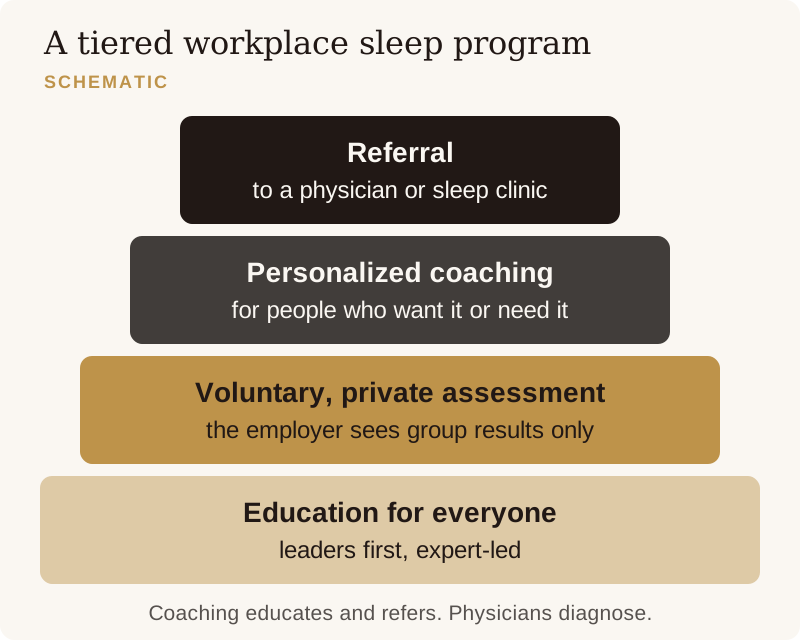
Why refer? Of 4,957 North American police officers, 40.4% screened positive for at least one sleep disorder, and most hadn't been diagnosed before. Those who screened positive reported more serious administrative errors and more falling asleep while driving.[7] Those outcomes were self-reported. If you snore loudly, wake up gasping, or feel exhausted despite a steady sleep window, talk to your physician.
My guidance is an eight-hour sleep window, to get at least seven hours of actual sleep. Seven hours of actual sleep is the consensus minimum for adults.[8] One more honest note: trials of sleep coaching as a named program are still small. The one I'd point to followed about 30 railway shift workers, with no comparison group and a different program from ours. Sleep quality improved, but daytime sleepiness didn't.[9] So most of the evidence below is for the parts coaching is built from.
Do workplace sleep programs work? What the research shows
Promising, but not settled. Here are the strongest pieces:
- A review of 60 articles on employer-led sleep efforts found that most reported better sleep and less sleepiness. Most studies weren't randomized, and the authors call the evidence "weak".[10]
- A randomized trial at an IT firm: employees got more control over their work time, and managers were trained to support family life, with nothing aimed directly at sleep. They slept 8 more minutes a night on a movement sensor, about an hour a week. The gain held at 18 months.[11][12] One university involved has a financial interest in a company that stands to gain from the results.
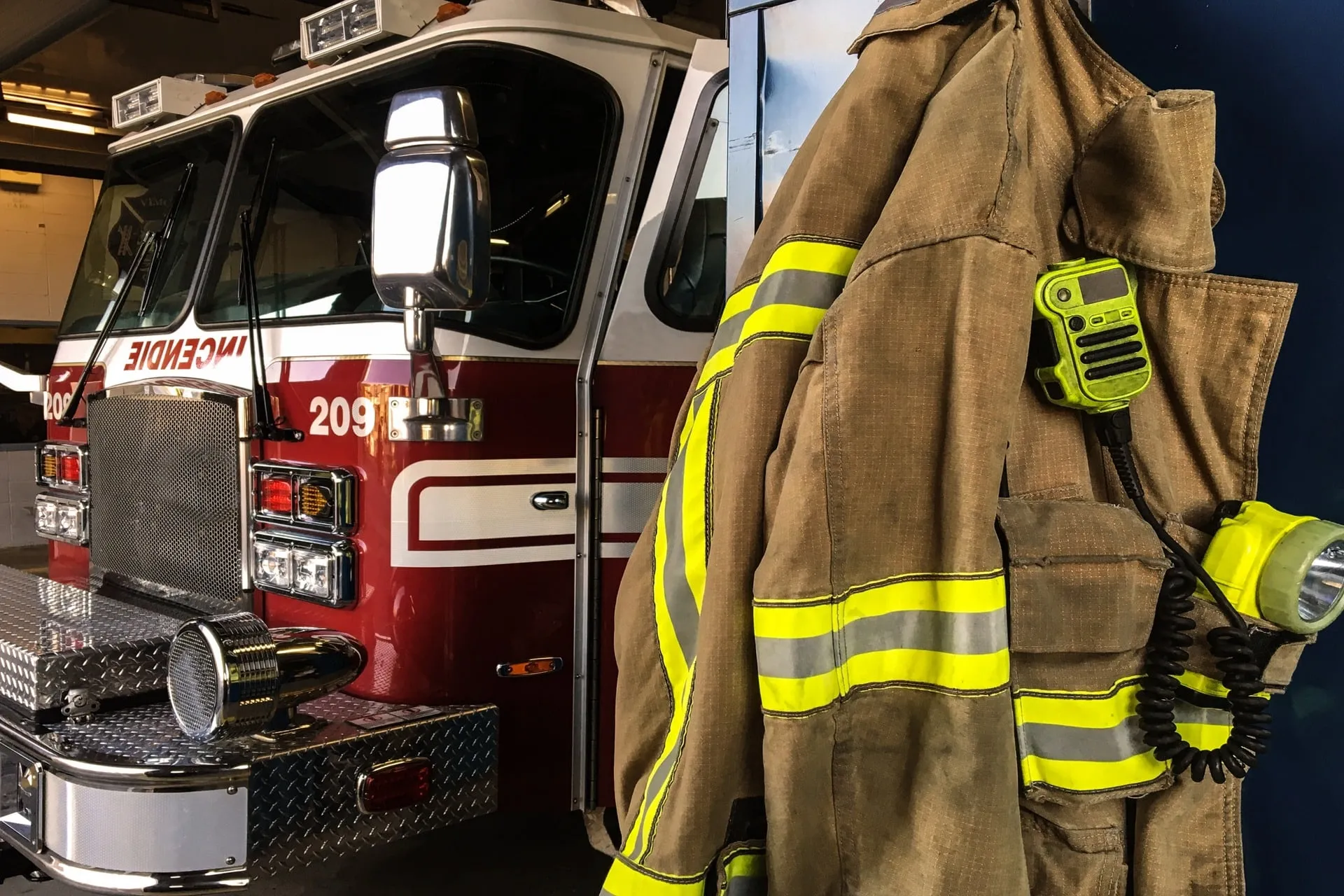
- A randomized trial of 1,189 firefighters: sleep education, screening and clinic referral were followed by 46% fewer disability days (1.4 against 2.6 per firefighter). Injury and crash rates did not differ significantly, and self-reported sleep didn't change.[13]
- Workplace insomnia programs are mostly cognitive behavioral therapy for insomnia (CBT-I), a structured, drug-free program that retrains sleep habits. A meta-analysis found a moderate drop in insomnia severity (about 2 points on a 28-point scale) across 827 workers.[16] In an online CBT-I trial, presenteeism improved but absenteeism didn't. One of its authors co-founded the company that makes the program.[17]
My read: the best results come when education, screening and follow-up work together, and many gains are short-term. That's why we won't promise you a return. We'll ask you to measure it.
Does it matter who delivers sleep education?
In one study, eight fire departments got the same sleep education and screening program in three ways: led by experts, train-the-trainer, or online. The expert-led version had the most firefighters complete the sleep screening and the biggest gains in knowledge. And among at-risk firefighters who answered the end-of-program survey, 41% in the expert-led departments said they had sought a clinical evaluation, against 20 to 25% for the other two.[14]
It was one sector, and the methods weren't randomized, so I wouldn't stretch it to every workplace. Online courses still have a place for distributed teams, alongside live sessions. Full disclosure: expert-led training is what we do at NEOS, so I'm not neutral here. I'm not trying to do a sales pitch. That's why I've shown you the studies.
The American College of Occupational and Environmental Medicine's fatigue guidance lists training and education fifth of the six core elements of a safety management system, the structure it builds fatigue risk management on.[15] I said this to a room of first responders in 2019:
“Training and education is there at fifth, and I would argue that it needs to be at the top. How could you create a safety management policy if you weren't trained and educated on this?”
How can an organization personalize the work itself?
Personalizing isn't only about coaching individuals. It can mean how work is scheduled. We need to stop fighting our physiology and start working with it.
In a German factory, early birds stopped working nights and night owls stopped working mornings. Their self-reported sleep improved, and the gap between work-day and free-day body clocks, called social jetlag, shrank by about an hour.[18] It was one factory, and not randomized.
The American Academy of Sleep Medicine lists 10 to 11 consecutive hours off in every 24 and limits on hours worked. It also lists sleep education for all, short naps during breaks, fatigue risk management systems and a path to a health-care provider.[19]
On naps: even 10 to 15 minutes can be restorative. Up to about 45 minutes is the sweet spot, and never over 90, because that isn't a nap, it's daytime sleep. The natural window is roughly six hours after waking. At most workplaces, take the length the day allows. Shift workers are a different case: a nap before the first night, and any chance to sleep on shift. See the best sleep schedule for night shift workers.
Around-the-clock work? See first responders and shift workers.
How do you roll out a sleep program in your organization?
Every workplace is different, so start with a day in the life of your workforce. And the goal isn't Elite Sleep® for everyone. It's the best sleep possible given the demands of the job. How far you take any of this is entirely up to you.
How do you measure the impact?
I'm a science guy, so here's my standard: let's put these things in place, and then let's measure them. Check at baseline, then at 3, 6 and 12 months. In the IT-firm trial, the sleep gains were still there at 18 months.[12]
- Participation.
- Sleep: duration and quality on validated questionnaires. Wearables only if people choose them.
- Presenteeism: a questionnaire such as the Work Productivity and Activity Impairment questionnaire, used in the online CBT-I trial.[17]
- Absence and disability days.
- Incident and near-miss reports.
- Engagement and retention.
Keep it private: results belong to the employee, and you see anonymized group data. Be wary of anyone who quotes you a guaranteed return. I think of this as cost recovery, because you're already paying for tired days. But that's a hypothesis you test, not a promise.
Frequently asked questions
What does a sleep coach do?
A sleep coach for adults and teams assesses a person's sleep, schedule and chronotype, builds a personal plan for timing, light, caffeine and naps, and adjusts it over time. It refers to a physician when a sleep disorder is suspected. It isn't diagnosis or treatment.
Is a sleep coach worth it?
Parts of it have some support: education, screening and referral went with 46% fewer disability days in a firefighter trial,[13] and expert-led delivery reached more people than online.[14] Trials of coaching as a named program are still small and uncontrolled.[9] To see where you stand, try the Free Sleep Assessment.
Do workplace sleep programs actually work?
Often for sleep and sleepiness, though a major review calls the evidence weak.[10] A generic wellness program did not move sleep quality.[5]
Why is sleep important in the workplace?
Insufficient sleep costs the US economy up to an estimated US$411 billion a year and Canada up to about C$27 billion.[1] For companies, one study estimated fatigue-related lost productivity at about US$1,967 per employee a year.[2] Officers who screened positive for a sleep disorder reported more serious administrative errors.[7]
What is a fatigue risk management system?
A fatigue risk management system (FRMS) manages fatigue risk in around-the-clock work through scheduling, hours-off rules, education, reporting and auditing. You cannot manage fatigue. The only way to manage fatigue is to get the sleep you need. You can manage the risk. The American Academy of Sleep Medicine lists FRMS as an employer strategy.[19]
For organizations
Plan a sleep program for your team
Education comes first. NEOS Performance offers expert-led workshops and sleep health programs, with personalized coaching for the people who want it, built around how your workplace actually runs.

About the author
Dr. Glenn J. Landry, PhD
Sleep and circadian rhythms scientist · Founder, NEOS Performance
Dr. Glenn J. Landry, PhD, is a sleep and circadian rhythms scientist with 30 years in sleep science, and the founder of NEOS Performance in Delta, BC. He came to this field honestly: he couldn't sleep, starting at 13. He earned his PhD at Simon Fraser University and completed a postdoctoral fellowship at the University of British Columbia, studying sleep, aging and cognition. He created the Surviving Shift Work® program. Today Dr. Landry and the NEOS team guide executives, shift workers, first responders and organizations toward Elite Sleep®, translating science for each person's lived experience.
More about Dr. Glenn J. Landry, PhD Sources (22)
- [1] Hafner M, Stepanek M, Taylor J, Troxel WM, van Stolk C. Why Sleep Matters: The Economic Costs of Insufficient Sleep. A Cross-Country Comparative Analysis. RAND Europe; 2016. (Upper-bound estimates of lost economic output for whole economies; the six-working-days figure is an estimate from self-reported productivity. RAND reports all countries in US dollars at 2015 prices; Canada: US$21.4 billion (1.35% of GDP). NEOS converted this to Canadian dollars at the Bank of Canada's 2015 average exchange rate (1.2787 CAD per USD): about C$27.4 billion.) Hafner et al., 2016 (RAND)
- [2] Rosekind MR, Gregory KB, Mallis MM, et al. The cost of poor sleep: workplace productivity loss and associated costs. Journal of Occupational and Environmental Medicine. 2010;52(1):91–98. Rosekind et al., 2010 (PubMed)
- [3] Hui SK, Grandner MA. Trouble sleeping associated with lower work performance and greater health care costs: longitudinal data from Kansas State employee wellness program. Journal of Occupational and Environmental Medicine. 2015;57(10):1031–1038. (An association, not proof of cause.) Hui & Grandner, 2015 (PubMed)
- [4] Centers for Disease Control and Prevention. Short sleep duration among workers — United States, 2010. MMWR. 2012;61(16):281–285. CDC MMWR, 2012 (PubMed)
- [5] Song Z, Baicker K. Effect of a workplace wellness program on employee health and economic outcomes: a randomized clinical trial. JAMA. 2019;321(15):1491–1501. (A general wellness program, not a sleep program.) Song & Baicker, 2019 (PubMed)
- [6] Van Dongen HP, Maislin G, Mullington JM, Dinges DF. The cumulative cost of additional wakefulness: dose-response effects on neurobehavioral functions and sleep physiology from chronic sleep restriction and total sleep deprivation. Sleep. 2003;26(2):117–126. Van Dongen et al., 2003 (PubMed)
- [7] Rajaratnam SM, Barger LK, Lockley SW, et al. Sleep disorders, health, and safety in police officers. JAMA. 2011;306(23):2567–2578. (Safety outcomes were self-reported.) Rajaratnam et al., 2011 (PubMed)
- [8] Watson NF, Badr MS, Belenky G, et al. Recommended amount of sleep for a healthy adult: a joint consensus statement of the American Academy of Sleep Medicine and Sleep Research Society. Journal of Clinical Sleep Medicine. 2015;11(6):591–592. Watson et al., 2015 (journal)
- [9] Holzinger B, Levec K, Munzinger MM, Mayer L, Klösch G. Managing daytime sleepiness with the help of sleepcoaching, a non-pharmacological treatment of non-restorative sleep. Sleep and Breathing. 2020;24(1):253–258. (About 30 railway shift workers, no control group; two authors helped design the program tested.) Holzinger et al., 2020 (PubMed)
- [10] Redeker NS, Caruso CC, Hashmi SD, Mullington JM, Grandner M, Morgenthaler TI. Workplace interventions to promote sleep health and an alert, healthy workforce. Journal of Clinical Sleep Medicine. 2019;15(4):649–657. Redeker et al., 2019 (PubMed)
- [11] Olson R, Crain TL, Bodner TE, et al. A workplace intervention improves sleep: results from the randomized controlled Work, Family, and Health Study. Sleep Health. 2015;1(1):55–65. Olson et al., 2015 (PubMed)
- [12] Crain TL, Hammer LB, Bodner T, Olson R, Kossek EE, Moen P, Buxton OM. Sustaining sleep: results from the randomized controlled Work, Family, and Health Study. Journal of Occupational Health Psychology. 2019;24(1):180–197. (Conflict of interest: Oregon Health & Science University, where authors work, has a financial interest in a company with a commercial interest in this intervention.) Crain et al., 2019 (PubMed)
- [13] Sullivan JP, O'Brien CS, Barger LK, Rajaratnam SM, Czeisler CA, Lockley SW. Randomized, prospective study of the impact of a sleep health program on firefighter injury and disability. Sleep. 2017;40(1). Sullivan et al., 2017 (PubMed)
- [14] Barger LK, O'Brien CS, Rajaratnam SM, et al. Implementing a sleep health education and sleep disorders screening program in fire departments: a comparison of methodology. Journal of Occupational and Environmental Medicine. 2016;58(6):601–609. (One sector; a comparison of methods, not randomized.) Barger et al., 2016 (PubMed)
- [15] Lerman SE, Eskin E, Flower DJ, et al. Fatigue risk management in the workplace (ACOEM guidance statement). Journal of Occupational and Environmental Medicine. 2012;54(2):231–258. Lerman et al., 2012 (journal)
- [16] Vega-Escaño J, Porcel-Gálvez AM, Diego-Cordero R, et al. Insomnia interventions in the workplace: a systematic review and meta-analysis. International Journal of Environmental Research and Public Health. 2020;17(17):6401. Vega-Escaño et al., 2020 (PubMed)
- [17] Bostock S, Luik AI, Espie CA. Sleep and productivity benefits of digital CBT for insomnia: a randomized controlled trial conducted in the workplace environment. Journal of Occupational and Environmental Medicine. 2016;58(7):683–689. (Co-author Colin Espie co-founded Big Health, which makes the program tested.) Bostock et al., 2016 (PubMed)
- [18] Vetter C, Fischer D, Matera JL, Roenneberg T. Aligning work and circadian time in shift workers improves sleep and reduces circadian disruption. Current Biology. 2015;25(7):907–911. (Small, non-randomized study in one factory.) Vetter et al., 2015 (PubMed)
- [19] American Academy of Sleep Medicine. Workplace interventions may improve sleep habits and duration for employees (news release on the Redeker et al. 2019 review, with its list of employer strategies). 2019. AASM news release, 2019 (AASM)
- [20] Nielsen HB, Hansen ÅM, Conway SH, et al. Short time between shifts and risk of injury among Danish hospital workers: a register-based cohort study. Scandinavian Journal of Work, Environment & Health. 2019;45(2):166–173. Nielsen et al., 2019 (PubMed)
- [21] Djupedal ILR, Harris A, Svensen E, et al. Shift Schedule With Fewer Short Daily Rest Periods and Sickness Absence Among Health Care Workers: A Cluster Randomized Clinical Trial. JAMA Network Open. 2025;8(9):e2531568. Djupedal et al., 2025 (PubMed)
- [22] Vedaa Ø, Harris A, Bjorvatn B, et al. Systematic review of the relationship between quick returns in rotating shift work and health-related outcomes. Ergonomics. 2016;59(1):1–14. Vedaa et al., 2016 (PubMed)