Sleep On It: Better Decisions Made Possible by Elite Sleep®

Dr. Glenn J. Landry, PhD · Sleep and circadian rhythms scientist
· 7 min read

The short version
Protecting your sleep is your best strategy for the decisions you make all day, 4 pm included. How long you sleep matters. So do when you sleep and how you treat the hours either side of your sleep window.
Here's how I teach it, one step at a time. Start with the step that fits your week.
Key takeaways
- Short nights weaken the brain's brake, and you may not notice.[3][7]
- Keep a steady sleep window: about the same bedtime and wake-up every day.
- Protect the two hours before bed: lights low and, in my method, blue blockers on.
- Start the day slowly. If you wake too early, light, your workout and breakfast all come a little later.
- Finish your coffee much earlier than you think, and give a drink time to clear.
Why does a short night show up in the afternoon?
Because the cost builds as the day goes on. Sleep pressure builds with every hour you're awake,[1] and a short night means you start the day with some already on the books. It even shows up in the body: in a review of 69 studies of physical performance, after a night without sleep or an earlier-than-normal wake-up, afternoon and evening performance dropped, while morning performance held up.[2]
Short nights, not just all-nighters, weaken executive function, the brain's brake.[3] Short sleep hits attention hardest: lapses come first.[4] After one night without sleep, the brain's emotion centre over-reacts to upsetting images, and its link to the brain's “brake” weakens.[5] One night without sleep also tilts decisions toward chasing gains over guarding against losses.[6]
And you may not feel it. Healthy adults limited to six hours or less in bed a night for two weeks ended up as impaired as after up to two nights without sleep, and were largely unaware of it.[7] That's the trap for a busy leader: you count your hours, you feel fine, and the cost shows up later in the day.
Add the afternoon lull. A review concluded that the post-lunch dip is real and can occur even without lunch, though only for some people and some tasks. A high-carbohydrate lunch worsens it.[8] In my teaching, for a regular sleeper the lull comes about six hours after waking.
What is your sleep accountant doing?
Balancing the books. It's what I call your sleep accountant, and as I put it in my course: “That sleep accountant tracks your days ... Was it physically strenuous? Was there a ton of new learning? Was it psychologically stressful? ... it's a ledger ... And then what the sleep accountant does is it looks at your sleep window and it says, okay, let's balance the books.”
A day of new learning and hard decisions is a day your accountant has to pay back. It pays in Deep, Light and REM Sleep, not in hours. So “not every night's sleep is going to be the same because not every day is the same ... the best approach is to let the sleep accountant do its job.”
Why does the window matter as much as the hours?
Your sleep window is where everything else starts. Your body clock learns from repetition. When bedtime and wake-up land at about the same time every day, it can start winding you down, and waking you up, on schedule.
The guidance I teach is 7 to 9 hours of actual sleep, which means an 8- to 10-hour sleep window. Set it by working back from the start of your day, not from a rule someone else gave you.
Two things set how alert or sleepy you feel: sleep pressure, which builds the longer you're awake, and your body clock.[1] Catch that first wave of sleepiness, and you tend to get into Deep Sleep sooner.
And if you get a second wind in the evening, that's normal. Researchers call it the wake maintenance zone: usually in the hours just before your normal bedtime, people rarely fall asleep, even when they try.[9][10]
How do you protect the two hours before bed?
Your own melatonin starts rising about two hours before your usual bedtime.[11] Even ordinary room light in that window can hold it back.[12] As I put it in my course: “you protect your night and your sleep window by beginning two hours before your bedtime, when melatonin would begin to rise. That's when you start blue blocking and you blue block through.”
In my method, the house lights go low and your blue blockers go on for those two hours. The aim is a ready brain, not a tired one. Stay up, keep it dim and easy, and if you start nodding off on the couch, get up and move for a minute.
Orange (amber) lenses block most blue light. In lab studies, they kept bright evening and night-time light from suppressing melatonin.[13][14] Whether they improve sleep itself is still mixed: some small trials found better sleep, others found no change.[15]
How should your morning start?
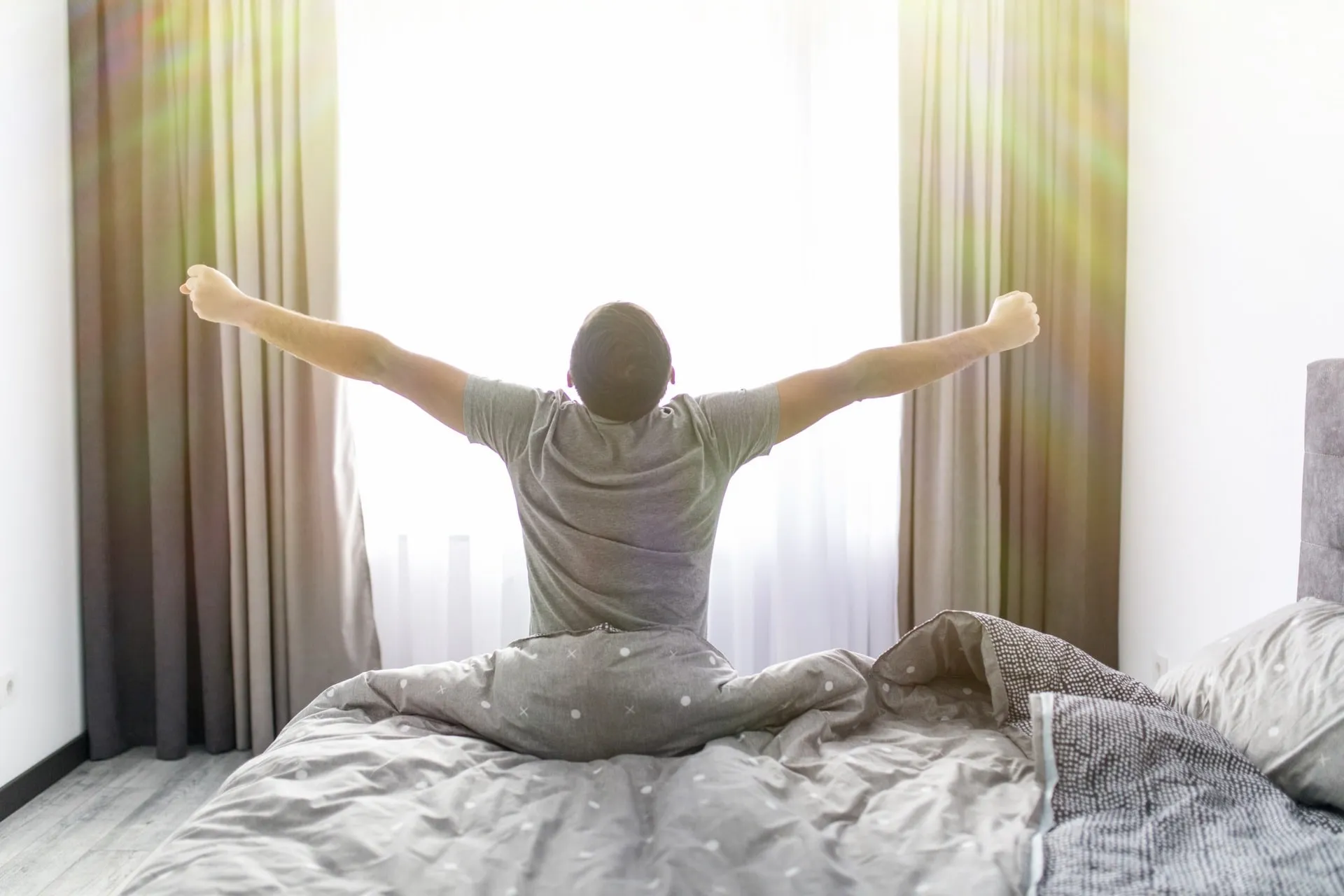
Slowly. I call it the golden three hours: the 90 minutes before and the 90 minutes after the wake-up time you chose. The first half is still your night. The second half is a slow start: dim, unhurried, not 100 miles an hour.
Then light. As I put it in my course: “We start off about an hour after waking up. We're going to have a light pulse ... This is the beginning of day ... Beginning, middle and end of day.”
If you wake too early, protect your morning from light and delay the start of your day. In my method that's a light strategy, and it's also about when you move and when you eat: bright light, your workout and breakfast all come a little later. If you're a night owl, it's the other way round: morning light helps move your clock earlier.
When should the coffee and the wine stop?
As I teach it, caffeine's half-life is roughly three to seven hours for most adults, and longer for some. As I put it in my course: “If you have coffee during the mid afternoon lull, that coffee's still going to be in your system when you're trying to go to bed.” Even at a fast 3-hour half-life, about 6% is still in you 12 hours later.
For me, “my rule of thumb is always to make sure that I have finished my coffee consumption before noon.” That's my habit, not a cut-off for you. But as I say in my course, “you need to finish your caffeine consumption much, much earlier than most would have thought.”
Alcohol? You don't have to give it up. “Let's be real about our lives ... we're still going to have a drink once in a while.” Give it time to clear before your sleep window; earlier and less both help. Alcohol cuts REM Sleep, even at about two drinks, and may break up the second half of the night.[18][19]
What about travel?
Travel is where a steady rhythm pays off. In my experience, you can handle it well if you start from an anchored rhythm and keep most of your routine. The plan depends on the direction you fly and how long you stay, and your blue blockers come with you. I cover it in its own article: how to handle jet lag, starting before you fly.
Do you have to get it right every night?
No. It's progress, not perfection. Aim for most nights, not every night, and start with the step that fits your week. I'm not judging at any time.
Coaching can work alongside your doctor's care, never instead of it.
Want to see what your own nights are doing?
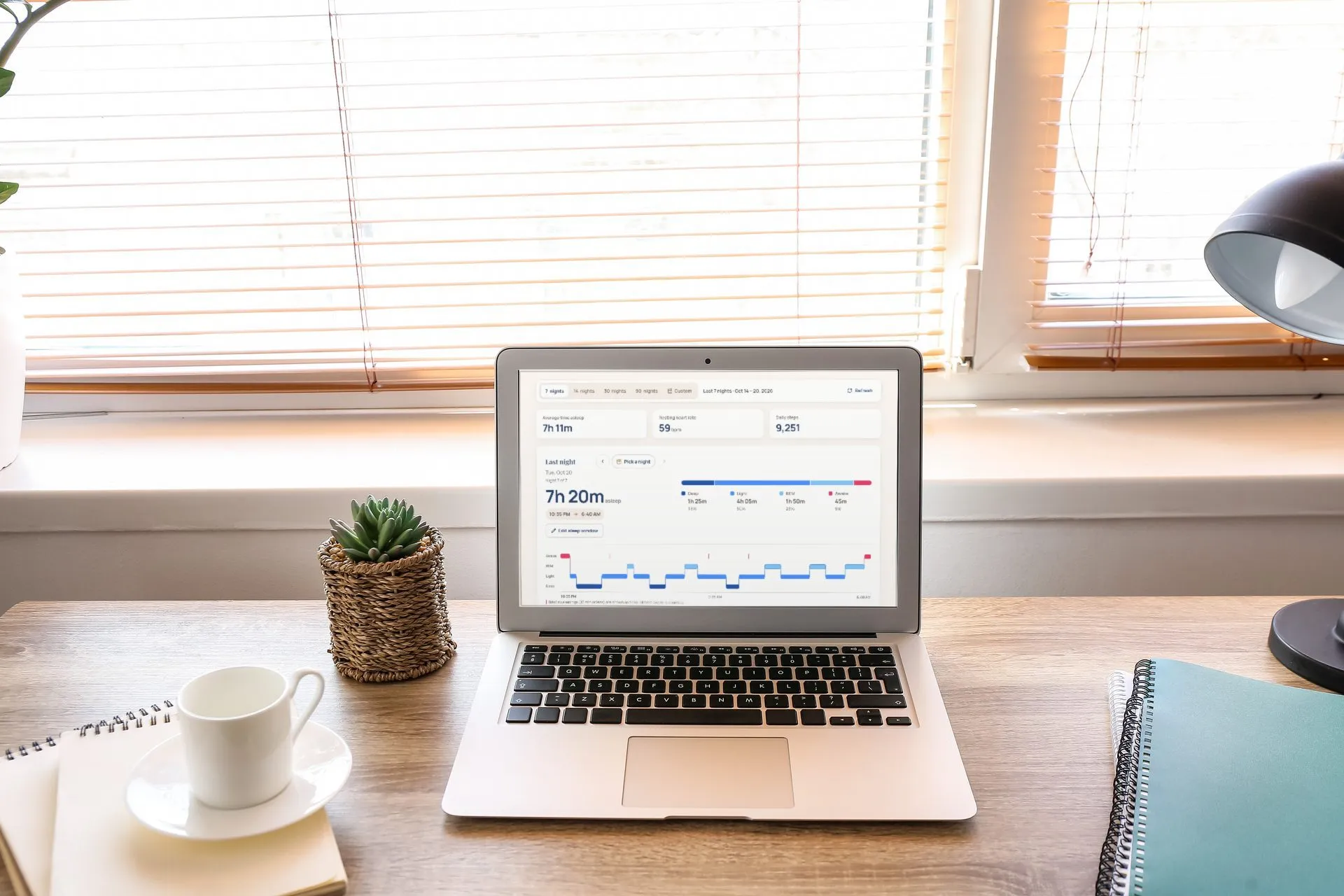
That's what the Advanced Sleep Assessment is for: at least a month of data from your own sleep tracker, reviewed with you, so you know which step matters most for you. If your results call for it, coaching is the next step.
Want this for your team? See Keynotes & live events.
Frequently asked questions
Why am I sharp in the morning and flat by mid-afternoon?
Partly your body clock and partly last night. Sleep pressure builds with every hour you're awake, and a short night means you start the day with some already on the books. The post-lunch dip is also real for some people and some tasks, even without lunch.
Do blue-light glasses help you sleep?
Orange lenses block most blue light and, in lab studies, kept evening light from suppressing melatonin. Whether they improve sleep itself is still mixed. In my method they go on for the two hours before bed. Never wear them while driving.
How late can I have coffee?
There's no single cut-off hour. As I teach it, caffeine's half-life is roughly three to seven hours for most adults, and longer for some, so finish it much earlier than most people think: the closer to bed, the more is still in your system.
For leaders
See what your nights are really doing
The Advanced Sleep Assessment by Dr. Glenn J. Landry, PhD, reviews at least a month of data from your own sleep tracker with you and shows you where to start.

About the author
Dr. Glenn J. Landry, PhD
Sleep and circadian rhythms scientist · Founder, NEOS Performance
Dr. Glenn J. Landry, PhD, is a sleep and circadian rhythms scientist with 30 years in sleep science, and the founder of NEOS Performance in Delta, BC. He came to this field honestly: he couldn't sleep, starting at 13. He earned his PhD at Simon Fraser University and completed a postdoctoral fellowship at the University of British Columbia, studying sleep, aging and cognition. He created the Surviving Shift Work® program. Today Dr. Landry and the NEOS team guide executives, shift workers, first responders and organizations toward Elite Sleep®, translating science for each person's lived experience.
More about Dr. Glenn J. Landry, PhD Sources (19)
- [1] Borbély AA, Daan S, Wirz-Justice A, Deboer T. The two-process model of sleep regulation: a reappraisal. Journal of Sleep Research. 2016;25(2):131–143. Borbély et al., 2016 (PubMed)
- [2] Craven J, McCartney D, Desbrow B, et al. Effects of acute sleep loss on physical performance: a systematic and meta-analytical review. Sports Medicine. 2022;52(11):2669–2690. (Meta-analysis of 69 studies of exercise performance.) Craven et al., 2022 (journal)
- [3] Lowe CJ, Safati A, Hall PA. The neurocognitive consequences of sleep restriction: a meta-analytic review. Neuroscience and Biobehavioral Reviews. 2017;80:586–604. (Meta-analysis of 61 studies.) Lowe et al., 2017 (journal)
- [4] Lim J, Dinges DF. A meta-analysis of the impact of short-term sleep deprivation on cognitive variables. Psychological Bulletin. 2010;136(3):375–389. Lim & Dinges, 2010 (PubMed)
- [5] Yoo SS, Gujar N, Hu P, Jolesz FA, Walker MP. The human emotional brain without sleep: a prefrontal amygdala disconnect. Current Biology. 2007;17(20):R877–R878. Yoo et al., 2007 (journal)
- [6] Venkatraman V, Huettel SA, Chuah LYM, Payne JW, Chee MWL. Sleep deprivation biases the neural mechanisms underlying economic preferences. Journal of Neuroscience. 2011;31(10):3712–3718. Venkatraman et al., 2011 (PubMed)
- [7] Van Dongen HPA, Maislin G, Mullington JM, Dinges DF. The cumulative cost of additional wakefulness: dose-response effects on neurobehavioral functions and sleep physiology from chronic sleep restriction and total sleep deprivation. Sleep. 2003;26(2):117–126. Van Dongen et al., 2003 (journal)
- [8] Monk TH. The post-lunch dip in performance. Clinics in Sports Medicine. 2005;24(2):e15–e23. (Narrative review.) Monk, 2005 (journal)
- [9] Lavie P. Ultrashort sleep-waking schedule. III. 'Gates' and 'forbidden zones' for sleep. Electroencephalography and Clinical Neurophysiology. 1986;63(5):414–425. Lavie, 1986 (journal)
- [10] Strogatz SH, Kronauer RE, Czeisler CA. Circadian pacemaker interferes with sleep onset at specific times each day: role in insomnia. American Journal of Physiology. 1987;253(1 Pt 2):R172–R178. Strogatz et al., 1987 (journal)
- [11] Burgess HJ, Savic N, Sletten T, Roach G, Gilbert SS, Dawson D. The relationship between the dim light melatonin onset and sleep on a regular schedule in young healthy adults. Behavioral Sleep Medicine. 2003;1(2):102–114. Burgess et al., 2003 (journal)
- [12] Gooley JJ, Chamberlain K, Smith KA, et al. Exposure to room light before bedtime suppresses melatonin onset and shortens melatonin duration in humans. Journal of Clinical Endocrinology and Metabolism. 2011;96(3):E463–E472. (Retrospective lab analysis, 116 adults aged 18 to 30.) Gooley et al., 2011 (journal)
- [13] van der Lely S, Frey S, Garbazza C, et al. Blue blocker glasses as a countermeasure for alerting effects of evening light-emitting diode screen exposure in male teenagers. Journal of Adolescent Health. 2015;56(1):113–119. van der Lely et al., 2015 (journal)
- [14] Kayumov L, Casper RF, Hawa RJ, et al. Blocking low-wavelength light prevents nocturnal melatonin suppression with no adverse effect on performance during simulated shift work. Journal of Clinical Endocrinology and Metabolism. 2005;90(5):2755–2761. Kayumov et al., 2005 (journal)
- [15] Shechter A, Quispe KA, Mizhquiri Barbecho JS, Slater C, Falzon L. Interventions to reduce short-wavelength (“blue”) light exposure at night and their effects on sleep: a systematic review and meta-analysis. Sleep Advances. 2020;1(1):zpaa002. Shechter et al., 2020 (journal)
- [16] Byrne S. 3 blue blockers put to the test. Consumer Reports. January 5, 2016. (Lab test of three products; not peer-reviewed.) Byrne, 2016 (consumerreports.org)
- [17] Leung TW, Li RW, Kee CS. Blue-light filtering spectacle lenses: optical and clinical performances. PLoS One. 2017;12(1):e0169114. Leung et al., 2017 (journal)
- [18] Ebrahim IO, Shapiro CM, Williams AJ, Fenwick PB. Alcohol and sleep I: effects on normal sleep. Alcoholism: Clinical and Experimental Research. 2013;37(4):539–549. Ebrahim et al., 2013 (PubMed)
- [19] Gardiner C, Weakley J, Burke LM, et al. The effect of alcohol on subsequent sleep in healthy adults: a systematic review and meta-analysis. Sleep Medicine Reviews. 2025;80:102030. (27 studies.) Gardiner et al., 2025 (journal)