Fall Back or Stay Put: Your Sleep and the Clock Change

Dr. Glenn J. Landry, PhD · Sleep and circadian rhythms scientist
· 4 min read

The short version
On Sunday, November 1, 2026, most of the United States and eastern Canada set their clocks back one hour. This year, most of western Canada doesn't: British Columbia, Alberta, Manitoba, the Northwest Territories and northwestern Ontario join Yukon and Saskatchewan in keeping one time all year.[1]
Either way, your sleep can stay steady. Falling back is the gentle change, and a steady wake-up time does most of the work. In the west, the bigger story is darker winter mornings.
Key takeaways
- Falling back is the gentle change: people slept about 30 to 40 minutes more that Sunday, not a full hour.[11]
- Keep your wake-up time steady by the clock, weekends included. It anchors your sleep window.
- In the west, sunrise on the shortest day moves about an hour later by the clock: about 9:50 AM in Edmonton.[15]
- Working across borders? This winter, Vancouver and Seattle are an hour apart, and Winnipeg shares Toronto's time.
Who falls back on November 1, and who doesn't?
Most of the United States and eastern Canada set their clocks back one hour at 2:00 AM on Sunday, November 1. In Canada, that includes most of Ontario, Quebec and Atlantic Canada.[1]
This year, the west is staying put:
- British Columbia: one time all year (UTC−7). March 8, 2026 was the province's final time change.[2]
- Alberta and the Northwest Territories: one time all year (UTC−6).[3][4]
- Manitoba and northwestern Ontario (Kenora, Dryden, Fort Frances and nearby): one time all year (UTC−5).[5][6]
- Yukon and Saskatchewan already keep one time all year, since 2020 and 1966.[7][8]
In the US, Congress has debated making daylight time permanent, but it hasn't become law.[9]
Does falling back affect your sleep?
Less than you might think. Falling back is the gentle change: the body clock adjusts to it more easily than to springing forward.[10]
And the extra hour? In a study of 7,211 adults wearing wrist trackers, people slept about 30 to 40 minutes more that Sunday, not a full hour.[11] Waking earlier over the following days can cancel much of that gain.[12]
“For night owls, spring forward is really brutal … for early birds it is the fall back that's hard.”
Here's the reason. Your body clock doesn't read the clock on the wall. The moment your body knows as 6:00 AM now reads 5:00 AM, so early birds may wake an hour earlier than they'd like. A small study points the same way.[13]
Evenings also get dark an hour earlier by the clock. If you walk or cycle home, make yourself easy to see.[14]
Staying on daylight time: what changes in the west?
In the west, nothing happens on the clock this Sunday. Your sleep window doesn't move.
What changes is the light. Your province or territory changed the clock, not the sun, so winter mornings will be darker by the clock and evenings lighter.
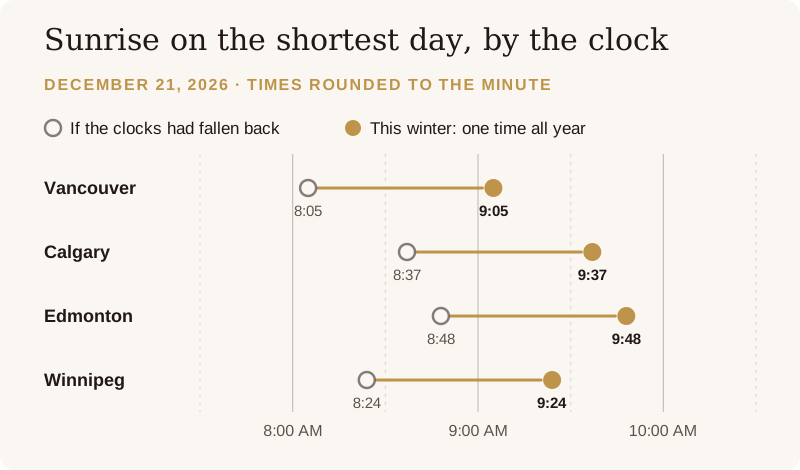
In Edmonton, the shortest day's sunrise moves from about 8:50 to about 9:50 AM. In Vancouver it's about 9:05, and in Winnipeg about 9:25.[15]
Sleep scientists recommend the other choice. The American Academy of Sleep Medicine, the Sleep Research Society and the Canadian Sleep Society all favor permanent standard time.[16][17][18][19] Their reason is timing: morning light moves the body clock earlier, and evening light moves it later.[20]
The Academy also notes that the long-term effects of year-round daylight time “have not been well studied.”[16] So this isn't a reason to worry. It's a reason to be deliberate about light.
How can I protect my sleep through the clock change?
It's not just what you do that matters, it's when you do it.
I don't recommend melatonin or sleep medications as a fix. If you're using them, talk to your physician before changing anything. And if you snore loudly, wake up gasping, or still feel exhausted with a steady sleep window, talk to your physician.
A clock change is one weekend. Your sleep window is every night.
Frequently asked questions
Does BC fall back on November 1, 2026?
No. Most of British Columbia now keeps one time all year (UTC−7); March 8, 2026 was its final time change.[2]
Do I get an extra hour of sleep when the clocks fall back?
Not quite. In a large study with wrist trackers, people slept about 30 to 40 minutes more that Sunday.[11]
Is the US switching to permanent daylight time?
Not now. Congress has debated it, but it hasn't become law, so most Americans fall back on November 1.[9]
For individuals
See how your sleep handles the change
Your Oura Ring, Fitbit or Apple Watch tells you what happened last night. We tell you what to do about it. Start with the Free Sleep Assessment. For ongoing guidance as the seasons change, there's the Elite Sleep® Coach (AI-Assisted).

About the author
Dr. Glenn J. Landry, PhD
Sleep and circadian rhythms scientist · Founder, NEOS Performance
Dr. Glenn J. Landry, PhD, is a sleep and circadian rhythms scientist with 30 years in sleep science, and the founder of NEOS Performance in Delta, BC. He came to this field honestly: he couldn't sleep, starting at 13. He earned his PhD at Simon Fraser University and completed a postdoctoral fellowship at the University of British Columbia, studying sleep, aging and cognition. He created the Surviving Shift Work® program. Today Dr. Landry and the NEOS team guide executives, shift workers, first responders and organizations toward Elite Sleep®, translating science for each person's lived experience.
More about Dr. Landry Sources (21)
- [1] Griffin K. Daylight time: Canadians confused as change approaches. CP24; October 16, 2026. Griffin, 2026 (cp24.com)
- [2] Government of British Columbia. Adopting permanent daylight saving time. BC Gov News; March 2, 2026. BC Gov News, March 2, 2026
- [3] Government of Alberta. Alberta's new time system (ABT). alberta.ca; accessed October 30, 2026. alberta.ca, Alberta's new time system
- [4] The Canadian Press. N.W.T. ends seasonal time change. CP24; September 23, 2026. The Canadian Press (CP24), September 23, 2026
- [5] IANA Time Zone Database. Release 2026e, September 29, 2026: “Manitoba moves to permanent -05 on 2026-10-31.” IANA tz database, release 2026e
- [6] Previl S. Kenora residents applaud “fantastic” move to permanent daylight time. Global News; October 15, 2026. Previl, 2026 (globalnews.ca)
- [7] Government of Yukon. Yukon Standard Time. yukon.ca; accessed October 30, 2026. yukon.ca, Yukon Standard Time
- [8] Government of Saskatchewan. Saskatchewan Time System. saskatchewan.ca; accessed October 30, 2026. saskatchewan.ca, Saskatchewan Time System
- [9] US Department of Transportation. Daylight saving time. transportation.gov; accessed October 30, 2026. US Department of Transportation
- [10] Kantermann T, Juda M, Merrow M, Roenneberg T. The human circadian clock's seasonal adjustment is disrupted by daylight saving time. Current Biology. 2007;17(22):1996–2000. Kantermann et al., 2007 (journal)
- [11] de Lange MA, Richmond RC, Birnie K, et al. The effects of daylight saving time clock changes on accelerometer-measured sleep duration in the UK Biobank. Journal of Sleep Research. 2025;34(3):e14335. (7,211 adults aged 43 to 78 in the autumn analysis.) de Lange et al., 2025 (journal)
- [12] Harrison Y. The impact of daylight saving time on sleep and related behaviours. Sleep Medicine Reviews. 2013;17(4):285–292. (Narrative review.) Harrison, 2013 (journal)
- [13] Lahti TA, Leppämäki S, Lönnqvist J, Partonen T. Transitions into and out of daylight saving time compromise sleep and the rest-activity cycles. BMC Physiology. 2008;8:3. (Small study, 9 adults.) Lahti et al., 2008 (journal)
- [14] Woods AN, Weast RA, Monfort SS. Daylight saving time and fatal crashes: the impact of changing light conditions. Journal of Safety Research. 2025;93:200–205. Woods et al., 2025 (journal)
- [15] NOAA Global Monitoring Laboratory. Solar Calculator. Sunrise times for December 21, 2026 computed by NEOS Performance with NOAA's solar formula. NOAA Solar Calculator
- [16] Rishi MA, Ahmed O, Barrantes Perez JH, et al. Daylight saving time: an American Academy of Sleep Medicine position statement. Journal of Clinical Sleep Medicine. 2020;16(10):1781–1784. Rishi et al., 2020 (journal)
- [17] Rishi MA, Cheng JY, Strang AR, et al. Permanent standard time is the optimal choice for health and safety: an American Academy of Sleep Medicine position statement. Journal of Clinical Sleep Medicine. 2024;20(1):121–125. Rishi et al., 2024 (journal)
- [18] Malow BA. It is time to abolish the clock change and adopt permanent standard time in the United States: a Sleep Research Society position statement. Sleep. 2022;45(12):zsac236. Malow, 2022 (journal)
- [19] Canadian Sleep Society. Position statement of the Canadian Sleep Society on the practice of daylight saving time (DST). css-scs.ca; March 7, 2023. Canadian Sleep Society, March 7, 2023
- [20] Roenneberg T, Winnebeck EC, Klerman EB. Daylight saving time and artificial time zones: a battle between biological and social times. Frontiers in Physiology. 2019;10:944. Roenneberg et al., 2019 (journal)
- [21] Gooley JJ, Chamberlain K, Smith KA, et al. Exposure to room light before bedtime suppresses melatonin onset and shortens melatonin duration in humans. Journal of Clinical Endocrinology and Metabolism. 2011;96(3):E463–E472. Gooley et al., 2011 (journal)